Žiča
Monastery of the Ascension of Christ, first seat of the independent Serbian church · Kraljevo
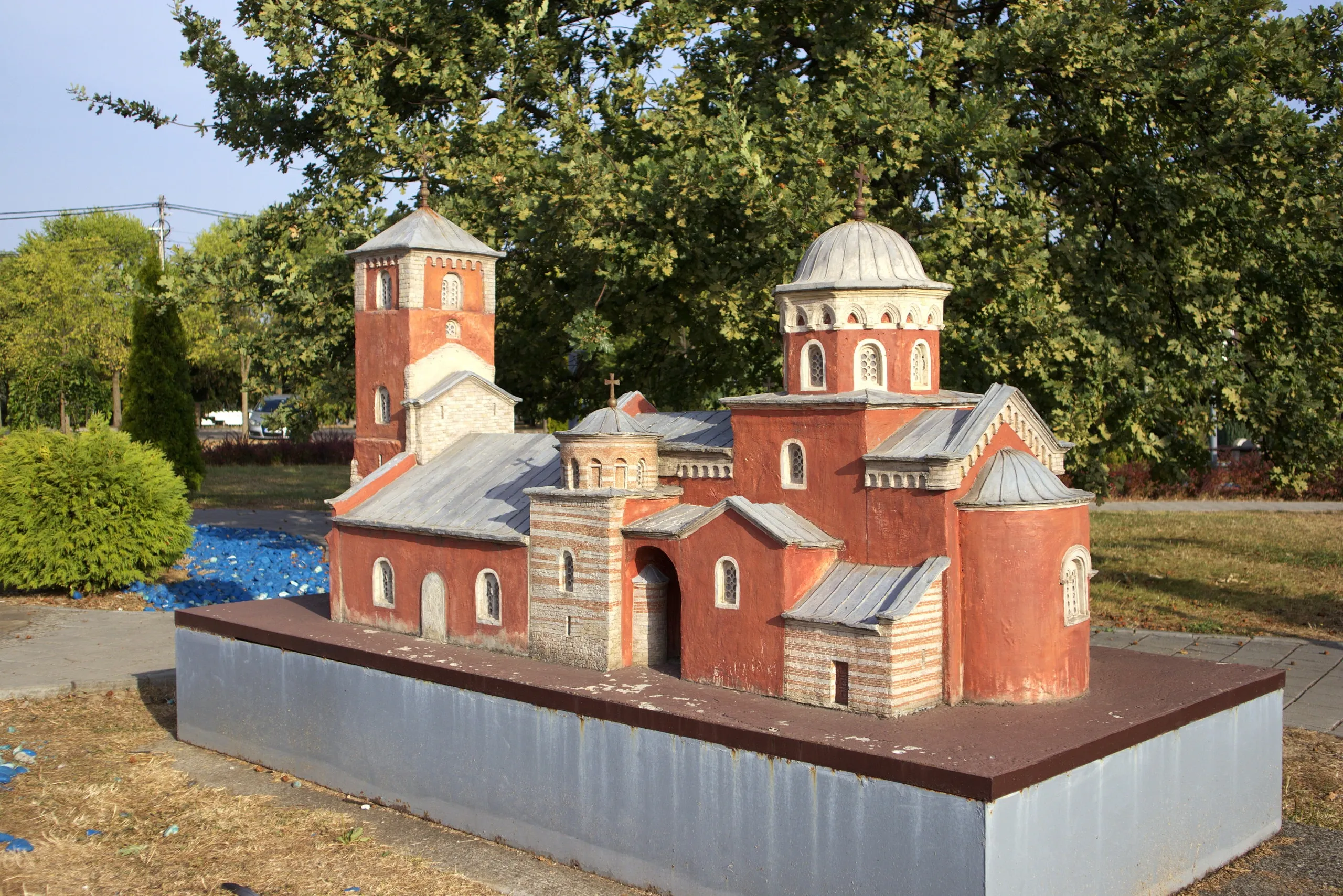
Žiča was built by Stefan the First-Crowned between 1206 and 1221. It was here that Saint Sava placed the seat of the independent Serbian archbishopric in 1219, and kings were crowned in it. Its red facades make it easy to recognise to this day.
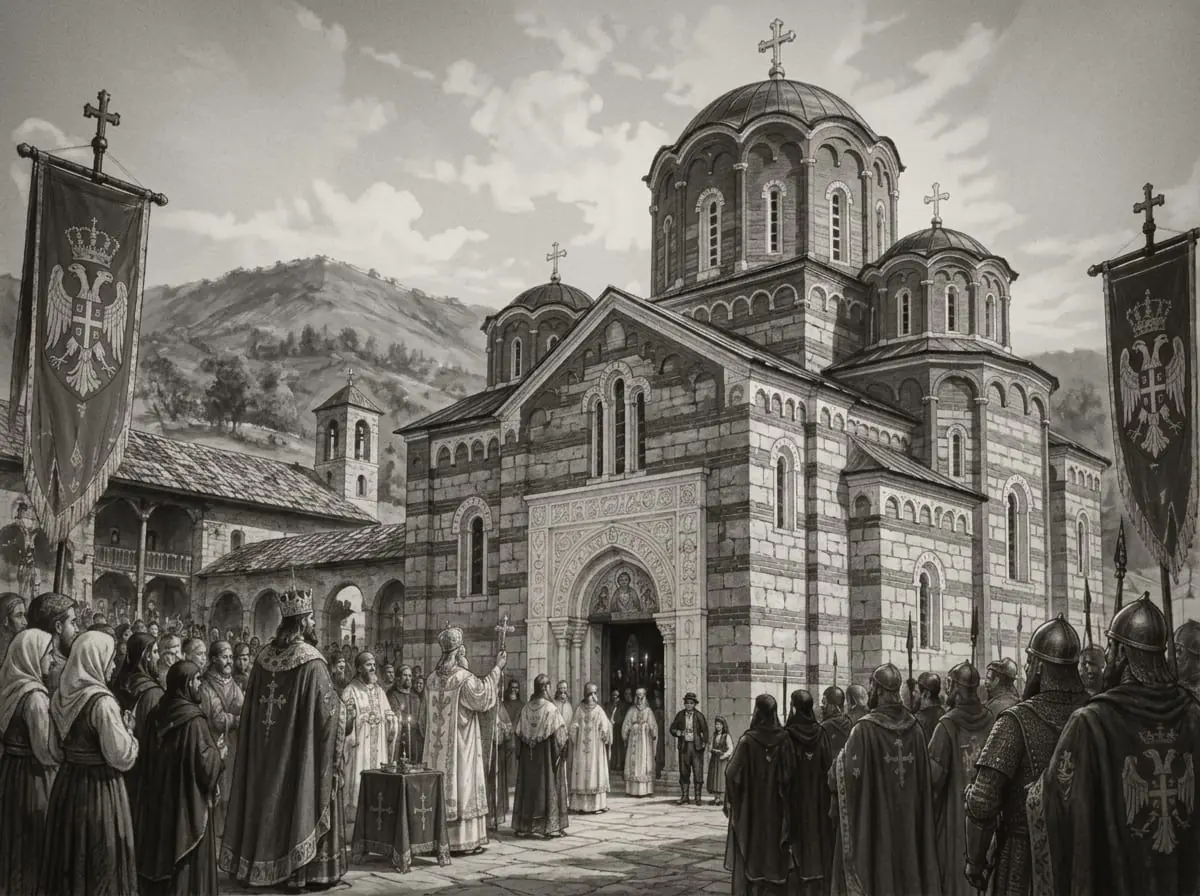
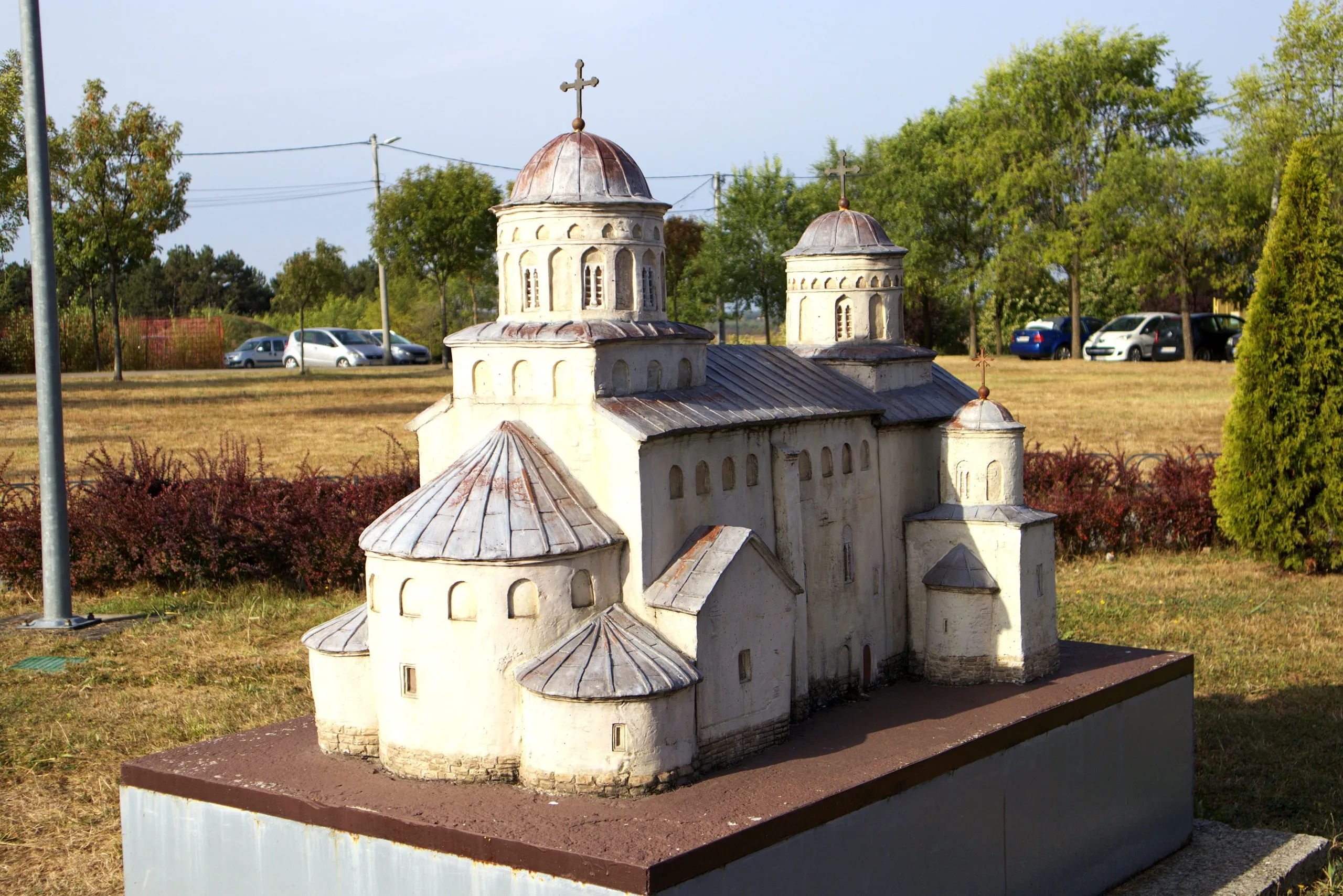
How it looked when it was built
Miniature and original
Gallery
Drag the slider and compare the miniature with the real Žiča near Kraljevo. Look out for the red colour of the facades and for the tower above the entrance.
History
When the Serbian church became independent in 1219, its first seat was not the old capital but King Stefan's new endowment, Žiča. Rulers were crowned in it and archbishops were enthroned there. That is why people remember it as “seven-doored” Žiča.
Read moreShow less
The monastery was built by Stefan Nemanjić, the middle son of Stefan Nemanja. Work began in 1206 or 1207, and the builders had largely finished the Church of the Ascension of Christ, or of the Holy Saviour, by 1221. In 1217 Stefan received a royal crown and is remembered as Stefan the First-Crowned, the first crowned king of the Nemanjić line.
His younger brother Sava played a great part in the raising of the monastery. When he was appointed the first Serbian archbishop in Nicaea in 1219, Sava placed the seat of the new, independent church in Žiča itself. According to the Republic Institute for the Protection of Cultural Monuments, he was also the mind behind some of the architectural solutions and the programme of the frescoes. He brought painters from Constantinople, who decorated the church.
On Ascension Day, the monastery's patronal feast, in 1221, Sava called a church and people's assembly at Žiča. There, by the Orthodox rite, he crowned his brother Stefan and ordained bishops, his own pupils. The First-Crowned wished future kings to be crowned at Žiča as well. Legend says that a new door was cut through for each new king, and so the monastery was called the Seven-Doored.
At the end of the 13th century the monastery was damaged in a plundering raid, most probably just after 1291. The seat of the archbishopric was then moved to the Church of the Holy Apostles near Peć. At the beginning of the 14th century Žiča was restored by King Milutin, so today there are two layers of frescoes in the church: an older one, from around 1220, and a younger one, from Milutin's time.
Under Turkish rule the monastery was deserted several times and came back to life again. Restoration began in 1856, and Kings Aleksandar and Petar of the modern era were also anointed at Žiča, continuing the Nemanjić tradition. The great restoration between the two world wars was carried out to a design by the architect Aleksandar Deroko, under the care of Bishop Nikolaj Velimirović. The small Church of Saint Sava was built at that time too.
On 10 October 1941 the German army bombed the Church of the Holy Saviour and burned the monastery buildings, the printing house and the library. After the earthquake of 1987 came a major conservation project, based on scholarly research and led by the architect Milka Čanak-Medić.
In 1979 Žiča was declared an immovable cultural property of exceptional importance. Today it is a convent of the Eparchy of Žiča, just outside Kraljevo.
People and events
Founder · c. 1166–1227
Stefan the First-Crowned
The middle son of Stefan Nemanja. He ruled as Grand Župan, and from 1217 as the first crowned King of Serbia. He built Žiča and decreed that Serbian kings should be crowned in it. He also wrote “The Life of Saint Simeon”, about his father. He is buried at Studenica.First Serbian archbishop · c. 1175–1235
Saint Sava
Rastko Nemanjić, the youngest son of Stefan Nemanja. He became a monk on Mount Athos and was abbot of Studenica. In 1219 he became the first archbishop of the independent Serbian church and placed its seat in Žiča. He influenced the appearance of the church and its frescoes.Restorer · c. 1253–1321
King Milutin
King of Serbia from 1282 to 1321. After the destruction at the end of the 13th century he restored Žiča, and his painters decorated the church a second time, repeating the original arrangement of the frescoes.Architect · 20th century
Aleksandar Deroko
The architect to whose design Žiča was restored between the two world wars. He also drew up the plan for the new bishop's residence.Event · 1219
Independent Serbian church
Sava Nemanjić becomes the first Serbian archbishop, and Žiča the seat of the autocephalous archbishopric.Event · 1221
Assembly at Žiča
On Ascension Day Sava calls a church and people's assembly, crowns his brother Stefan by the Orthodox rite and appoints bishops.Event · after 1291
Destruction and transfer of the seat
The monastery is damaged in a plundering raid, and the seat of the archbishopric moves to Peć. At the beginning of the 14th century King Milutin restores Žiča.Event · 1941
Bombing
The German army bombs the church and burns the monastery buildings, the printing house and the library.Event · 1987
Earthquake and restoration
An earthquake damages the monastery; the restoration returns the Church of the Holy Saviour to its early 13th-century appearance.
From literature
О, радуј се, лавро седмовратна Света Жичо на Морави хладној! Ужди своје пламене олтаре, Отпој славу Богу великоме, Задужбино Богу посвећена;
With these verses, in 1903, Aleksa Šantić greets Žiča as the coronation monastery, at the moment when Serbia is gaining a new king. The name “seven-doored” recalls the legend of the doors that are opened for each new king.
Architecture
Raška school
Žiča is one of the first and most important churches of the Raška school of architecture. Its appearance later became a model for many Serbian churches of the 13th century.
The church has a single nave with a dome, and at the sides are rectangular choirs and side chapels. On the east is a wide apse, and on the west an inner and an outer narthex with a tall tower. The facades are painted red, after the example of the monasteries of Mount Athos, and along the roof cornices run small Romanesque marble arches (arcading). To the east of the main church stands the small 14th-century Church of Saints Theodore Tiron and Theodore Stratelates.
Where is the original
Kraljevo
Related monuments
Sources(6)
- Republički zavod za zaštitu spomenika kulture – Beograd, Manastir Žiča (SK 159), Informacioni sistem nepokretnih kulturnih dobara, Republički zavod za zaštitu spomenika kulture (pristupljeno 4. 10. 2026), 2026
- Vikipedija (sr), Manastir Žiča, Vikipedija na srpskom jeziku, revizija 31046273 (pristupljeno 4. 10. 2026), 2026
- Vikipedija (sr), Stefan Nemanjić, Vikipedija na srpskom jeziku, revizija 31684135 (pristupljeno 4. 10. 2026), 2026
- Aleksa Šantić, Neimenovana pesma („Gore naše propojte veseljem…“), 1903, Tekst prema Vikizvorniku, revizija 10720, 1903
- Vikipedija (sr), Sveti Sava, Vikipedija na srpskom jeziku, revizija 31089418 (pristupljeno 4. 10. 2026), 2026
- Vikipedija (sr), Stefan Milutin, Vikipedija na srpskom jeziku, revizija 31740188 (pristupljeno 4. 10. 2026), 2026