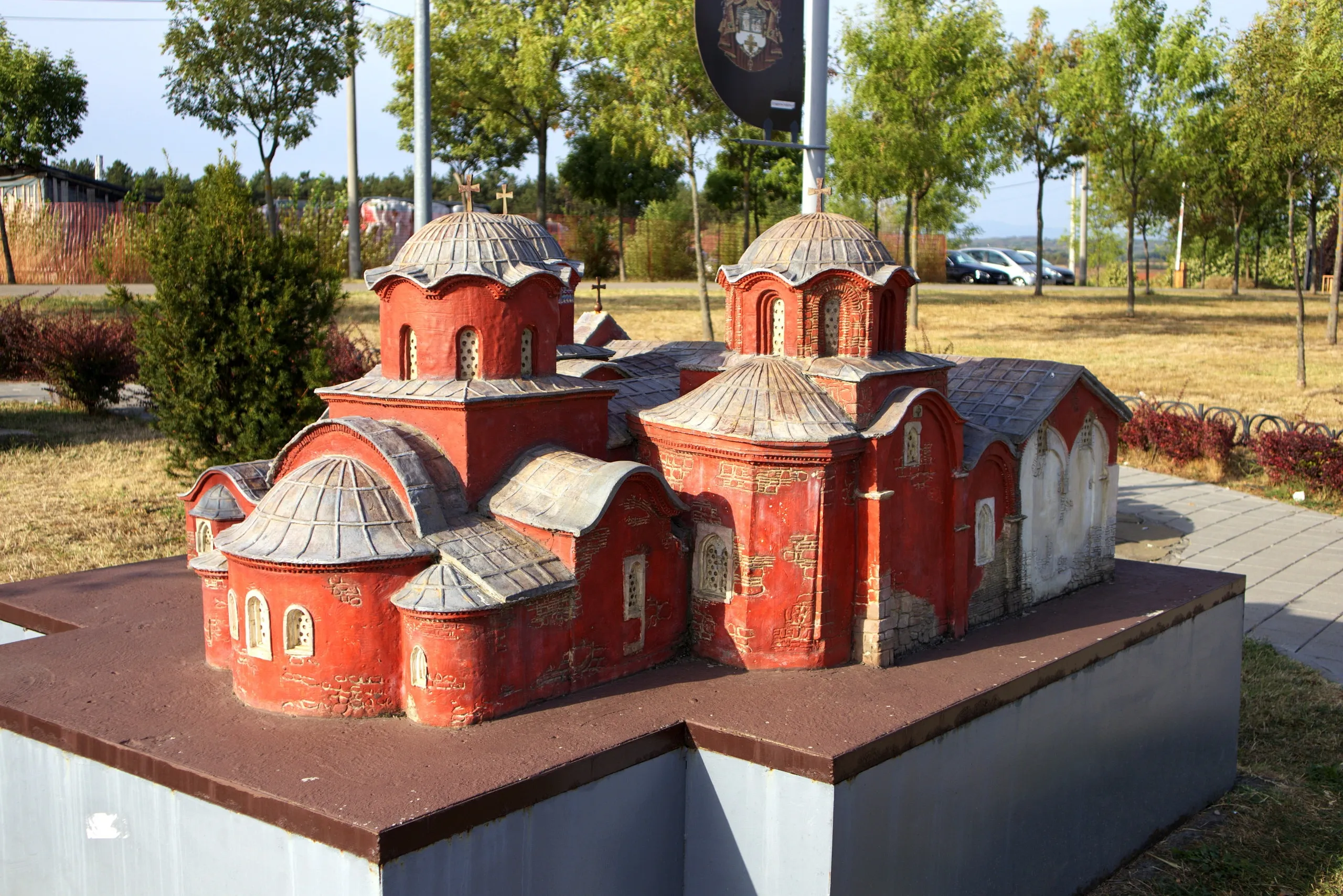
Patriarchate of Peć
A monastery of four churches, for centuries the seat of the Serbian archbishops and patriarchs · Peć
At the entrance to the Rugova Gorge, near Peć, four joined churches from the 13th and 14th centuries make up the monastery of the Patriarchate of Peć. For centuries it was the seat and burial place of the Serbian archbishops and patriarchs. Since 2006 it has been part of the UNESCO World Heritage.
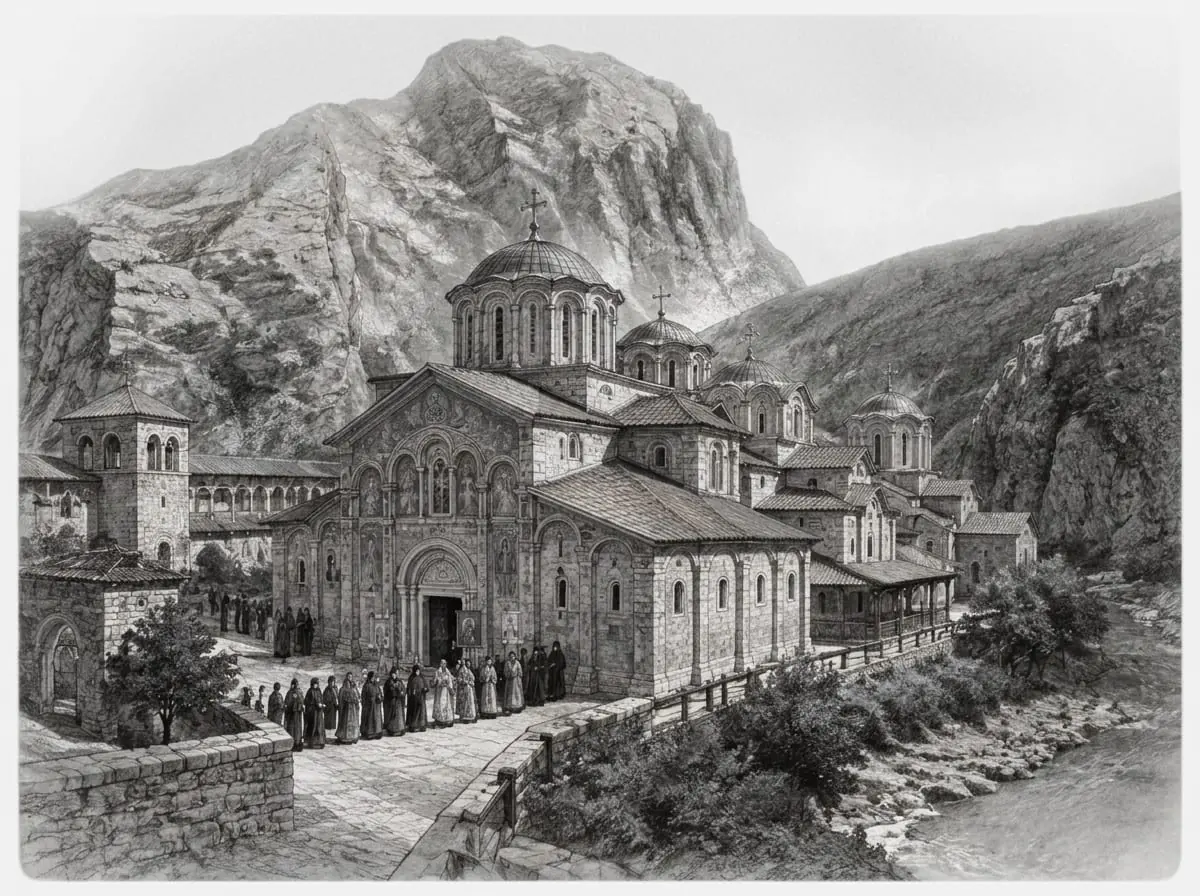
How it looked when it was built
Miniature and original
Gallery
Drag the slider and compare the miniature with the real Patriarchate of Peć. Pay attention to how the four churches are joined by the shared narthex.
History
When Žiča was damaged at the end of the 13th century, the heads of the Serbian church found a new home near Peć, at the entrance to the gorge of the Pećka Bistrica river. There they built their churches, one beside the other, and there they were buried. Since 1346 this has been the seat of the Serbian patriarch.
Read moreShow less
While Saint Sava was still alive, a metochion (a dependent estate) of the Žiča monastery was founded on this spot. The second Serbian archbishop, Arsenije I, built the Church of the Holy Apostles on it. Thanks to Arsenije the church was painted around 1260. He wanted the centre of the church to be in a less exposed place, closer to the centre of the state.
The archbishops who followed kept building. Archbishop Nikodim built the Church of Saint Demetrius along the northern side of the Holy Apostles. Archbishop Danilo II, a writer and learned monk, built the Church of the Virgin Hodegetria and the small Church of Saint Nicholas on the southern side. In front of all three large churches he raised a monumental narthex in the form of an open porch, with a tall tower. That is how a unique group of four churches joined by one narthex came about.
In 1346, at the time when the Serbian Empire was being created, the Serbian archbishopric was raised to the rank of a patriarchate. At the assembly in Skopje, Archbishop Joanikije II was proclaimed the first Serbian patriarch, with his seat in the monastery at Peć. Hence the name Patriarchate of Peć.
After the Serbian lands fell under Turkish rule the patriarchate ceased to exist, and the Serbian eparchies came under the Archbishopric of Ohrid. It was restored in 1557, with the election of Patriarch Makarije Sokolović, and once again gathered Orthodox Serbs under one church authority. At that time the openings of Danilo's narthex were walled up, and in 1565 it was painted with frescoes. The Patriarchate of Peć was abolished in 1766, and its eparchies were placed under the Patriarchate of Constantinople.
In the 19th century the monastery was plundered several times, but the monks and abbots persistently raised new buildings. After the unification of the Serbian church, Patriarch Dimitrije was enthroned in Peć in 1924, and since then all Serbian patriarchs have been enthroned in the Patriarchate of Peć. Conservation work in 1931–1932, led by the architect Đurđe Bošković, partly brought back the original appearance.
The monastery is an immovable cultural property of exceptional importance. In 2006 UNESCO inscribed it on the World Heritage List, as part of the property “Medieval Monuments in Kosovo”, and at the same time on the List of World Heritage in Danger.
People and events
Founder of the Church of the Holy Apostles · ? – 1266
Archbishop Arsenije I
Successor of Saint Sava and second Serbian archbishop, from 1233 to 1263. On the Žiča metochion near Peć he built the Church of the Holy Apostles and saw to it that it was painted. The Serbian Orthodox Church celebrates him as a saint.Founder and writer · c. 1270–1337
Archbishop Danilo II
Serbian archbishop from 1324 to 1337, earlier abbot of Hilandar. He built the churches of the Virgin Hodegetria and Saint Nicholas and the great narthex with the tower. He was also an important writer, the author of lives of the Serbian kings and archbishops.Restorer of the patriarchate · patriarch 1557–1571
Patriarch Makarije Sokolović
Elected in 1557, when the Serbian Patriarchate was restored with its centre in Peć. He secured its recognition and survival, so he is considered one of the most important heads of the Serbian church.Painter · 17th century
Georgije Mitrofanović
One of the most gifted painters of his time. Around 1619/1620 he restored the frescoes in the Church of Saint Demetrius and painted the monastery refectory.Event · 1346
The Serbian Patriarchate
At the assembly in Skopje, Archbishop Joanikije II is proclaimed the first Serbian patriarch, with his seat in Peć.Event · 1557
Restoration of the patriarchate
With the election of Makarije Sokolović, the Serbian Patriarchate is restored with its seat in Peć.Event · 1766
Abolition
The Patriarchate of Peć is abolished, and its eparchies are placed under the Patriarchate of Constantinople.Event · 1924
Enthronement of Patriarch Dimitrije
After the unification of the Serbian church, the first patriarch of the restored patriarchate is enthroned in Peć; since then all Serbian patriarchs have been enthroned there.Event · 2006
World Heritage
UNESCO inscribes the monastery on the World Heritage List, as part of the property “Medieval Monuments in Kosovo”.
From literature
Саградише Високе Дечане, Баш Дечане више Ђаковице; Паћаршију више Пећи равне;
In the folk poem “Zidanje Ravanice” (“The Building of Ravanica”), Princess Milica lists the endowments of the Nemanjić dynasty to encourage Prince Lazar to build a church of his own. Among the first she mentions “Паћаршију више Пећи равне”: Paćaršija is what the people called the Patriarchate of Peć, the seat of the Serbian patriarchs.
Architecture
Raška school
The Patriarchate of Peć is not one church but four churches joined into a whole. In the middle is the oldest, the Church of the Holy Apostles. On its northern side is the Church of Saint Demetrius, and on its southern side the Church of the Virgin Hodegetria and the small Church of Saint Nicholas.
In front of the western facades of the three large churches, Archbishop Danilo II raised a monumental narthex. Originally it was an open porch with double arcades, and in the 16th century the openings were walled up. On the walls of the churches at Peć you can follow the whole history of the styles of Serbian medieval wall painting, from the 13th to the 17th century. The painting of the facades red in 2008 caused sharp debate among experts.
Where is the original
Peć · UNESCO World Heritage
Related monuments
Sources(7)
- Republički zavod za zaštitu spomenika kulture – Beograd, Manastir Pećka patrijaršija (SK 1370), Informacioni sistem nepokretnih kulturnih dobara, Republički zavod za zaštitu spomenika kulture (pristupljeno 4. 10. 2026), 2026
- Vikipedija (sr), Manastir Pećka patrijaršija, Vikipedija na srpskom jeziku, revizija 31447371 (pristupljeno 4. 10. 2026), 2026
- Vikipedija (sr), Pećka patrijaršija, Vikipedija na srpskom jeziku, revizija 30852777 (pristupljeno 4. 10. 2026), 2026
- Vikipedija (sr), Arhiepiskop srpski Arsenije I, Vikipedija na srpskom jeziku, revizija 31714293 (pristupljeno 4. 10. 2026), 2026
- Vikipedija (sr), Arhiepiskop srpski Danilo II, Vikipedija na srpskom jeziku, revizija 31713860 (pristupljeno 4. 10. 2026), 2026
- Vikipedija (sr), Patrijarh srpski Makarije, Vikipedija na srpskom jeziku, revizija 31508593 (pristupljeno 4. 10. 2026), 2026
- Vuk Stefanović Karadžić (sakupio i izdao), Zidanje Ravanice, u: Srpske narodne pjesme, knjiga druga, Tekst prema Vikizvorniku, revizija 79993