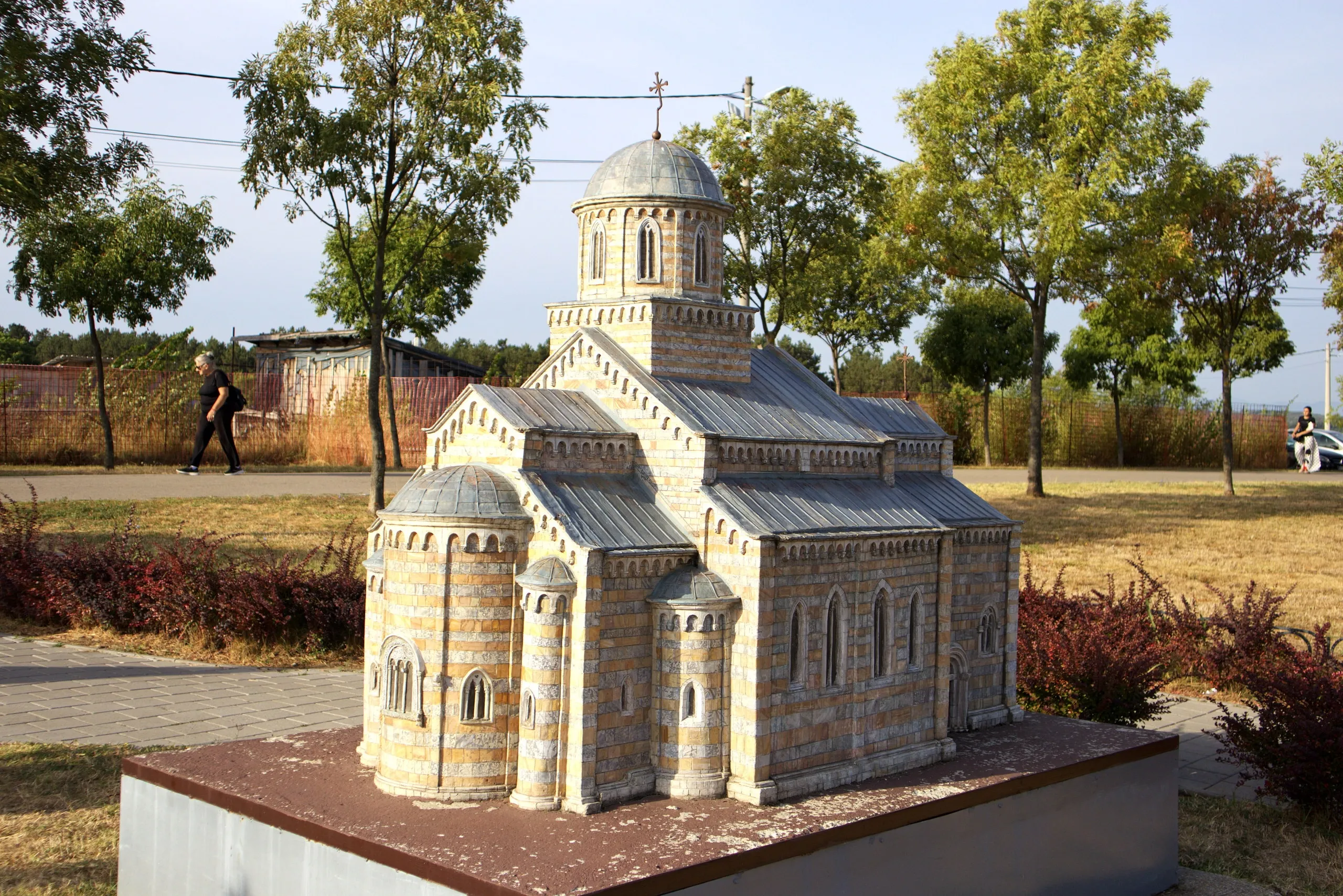
Visoki Dečani
Monastery with the Church of Christ Pantocrator, endowment of King Stefan Dečanski · Dečani
Dečani was founded by King Stefan Dečanski as his endowment and burial place, and completed by his son Dušan. The church of marble in two colours, built 1327–1335, is among the largest buildings of medieval Serbia. Its frescoes include more than a thousand figures and scenes.
How it looked when it was built
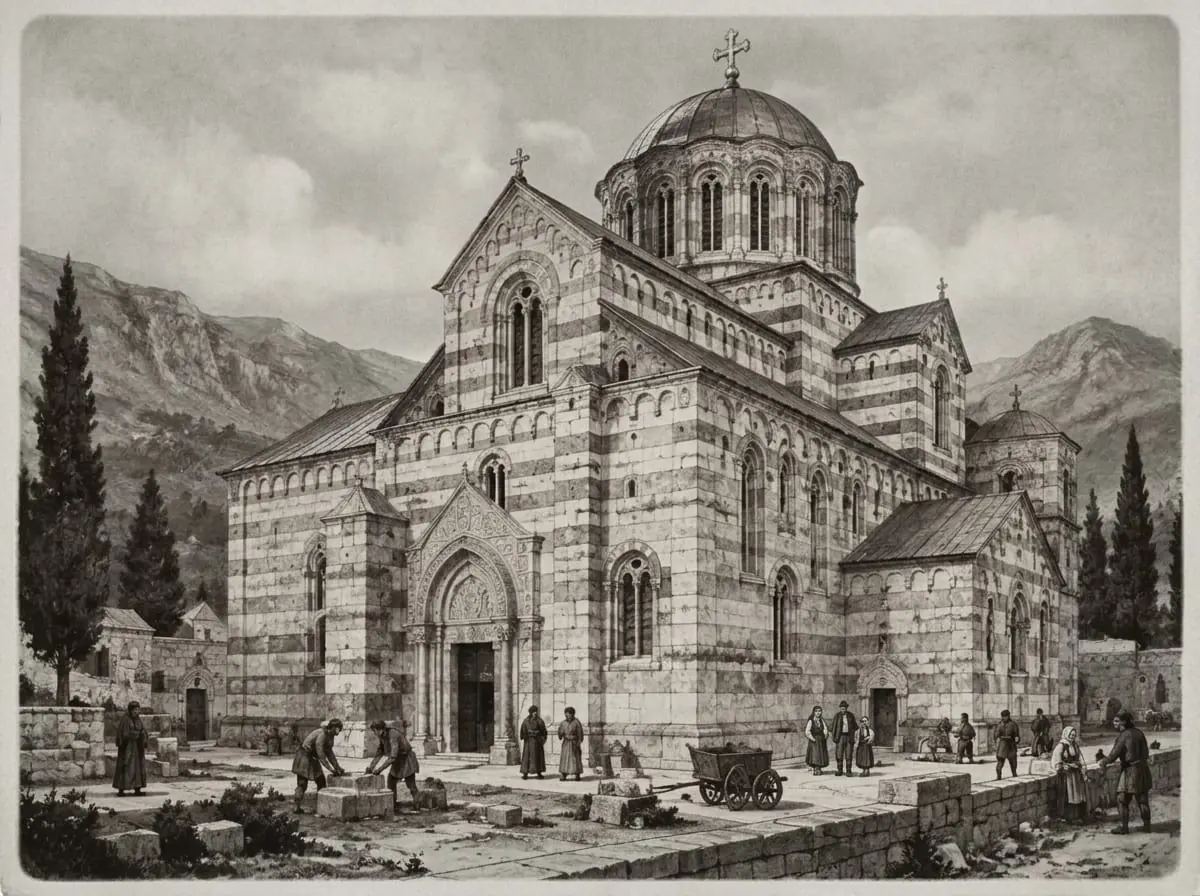
Miniature and original
Gallery
Drag the slider and compare the miniature with the real Visoki Dečani. Look out for the bands of marble in two colours and for the stone decoration around the windows.
History
In the valley of the Dečanska Bistrica river, beneath the Prokletije mountains, stands one of the largest churches of medieval Serbia. It was built by King Stefan Dečanski and completed by his son Dušan. Because of its unusual height the monastery was named Visoki Dečani, “High Dečani”.
Read moreShow less
In the founding charter King Stefan Uroš III wrote that the site for the church, “which is called Dečani”, had been chosen long before by Saint Sava, who did not manage to build a church on it. Construction of the church dedicated to Christ Pantocrator (the Almighty) began in 1327. In 1330 the king issued a charter richly endowing his foundation. It is because of this endowment that he himself is remembered as Stefan Dečanski.
The chief builder was Fra Vita of Kotor, a Franciscan. He dressed the plan and structure of an Orthodox church in Romanesque facades, with an abundance of stone decoration. The work was supervised by Archbishop Danilo II. King Stefan died in 1331, and the building was continued, and finished around 1335, by his son Stefan Dušan, the future emperor.
Painting the church went on for years more, until the middle of the 14th century. The frescoes survive almost in their entirety and include more than a thousand individual figures and scenes, arranged in more than twenty cycles.
The relics of King Stefan Dečanski, whom the Serbian Orthodox Church celebrates as a saint, rest in the monastery. Under Turkish rule Dečani survived in difficult circumstances. The monastery's scriptorium, where liturgical and theological books were copied, was especially important. In the 19th century, Prince Miloš built one of the residential buildings in 1836, and in 1849 Prince Aleksandar Karađorđević donated a reliquary (casket) for the relics of Stefan Dečanski. The Dečani collection of manuscript books ranks in importance right after that of Hilandar, and the treasury holds around sixty icons from the 14th–17th centuries.
Conservation work on the whole complex has been going on since the 1930s. The monastery is an immovable cultural property of exceptional importance. UNESCO inscribed it on the World Heritage List in 2004, and in 2006 the property “Medieval Monuments in Kosovo”, to which Dečani belongs, was also inscribed on the List of World Heritage in Danger. The monastery belongs to the Eparchy of Raška and Prizren.
People and events
Founder · c. 1275/1284–1331
King Stefan Dečanski
Stefan Uroš III, son of King Milutin and father of Emperor Dušan, King of Serbia from 1321 to 1331. He founded Dečani as his endowment and burial place. His relics rest in the monastery, and the Serbian Orthodox Church celebrates him as a saint.Completed the building · c. 1308/1312–1355
Stefan Dušan
Son of Stefan Dečanski, king from 1331 and the first Serbian emperor from 1346. After his father's death he continued and completed the building of Dečani.Builder · 14th century
Fra Vita of Kotor
A Franciscan from Kotor, chief builder of the Dečani church. He dressed the Orthodox church in Romanesque stone facades, with rich sculptural decoration.Supervised the building · c. 1270–1337
Archbishop Danilo II
Serbian archbishop and writer, who supervised the building of the Dečani church.Event · 1327
Building begins
King Stefan Uroš III begins building the Church of Christ Pantocrator.Event · 1330
Founding charter
The king issues a charter richly endowing his foundation.Event · c. 1335
Building completed
Stefan Dušan completes the building begun by his father.Event · 2004
World Heritage
UNESCO inscribes Dečani Monastery on the World Heritage List.
From literature
Тек поклон' ми то село Дечане, Та Дечане више Истинице, Код студене код воде Бистрице, Међу Пећи међу Ђаковицом: Хоћу, царе, манастира градит'.
In the folk poem “The Building of Visoki Dečani”, the old King Stefan leaves the whole empire to his son and asks only one thing for himself: the village of Dečani, so that he can build a monastery there. The poem ends with verses about a monastery that is “higher, so that there is none higher”.
Architecture
Raška school
The Dečani Church of Christ Pantocrator is among the largest buildings of medieval Serbia. It is built of marble blocks in two colours, which alternate in bands. In it, the Romanesque and Gothic of the West are interwoven with the Byzantine tradition of the East.
The ground plan of the church builds on the experience of Raška architecture, and above the middle rises a dome on a raised square base. The portals and windows are richly decorated with stone sculpture. The iconostasis with its principal icons is original, as is most of the church furniture. Unlike the church, the other monastery buildings have mostly lost their original appearance.
Where is the original
Dečani · UNESCO World Heritage
Related monuments
Sources(6)
- Republički zavod za zaštitu spomenika kulture – Beograd, Manastir Dečani (SK 1368), Informacioni sistem nepokretnih kulturnih dobara, Republički zavod za zaštitu spomenika kulture (pristupljeno 4. 10. 2026), 2026
- Vikipedija (sr), Manastir Visoki Dečani, Vikipedija na srpskom jeziku, revizija 30970014 (pristupljeno 4. 10. 2026), 2026
- Vikipedija (sr), Stefan Uroš III, Vikipedija na srpskom jeziku, revizija 31607640 (pristupljeno 4. 10. 2026), 2026
- Vikipedija (sr), Stefan Dušan, Vikipedija na srpskom jeziku, revizija 31736097 (pristupljeno 4. 10. 2026), 2026
- Narodna pesma, Zidanje Visokih Dečana, u: Bratstvo, br. 2, Društvo Svetoga Save; tekst prema Vikizvorniku, revizija 104477, 1888
- Vikipedija (sr), Arhiepiskop srpski Danilo II, Vikipedija na srpskom jeziku, revizija 31713860 (pristupljeno 4. 10. 2026), 2026