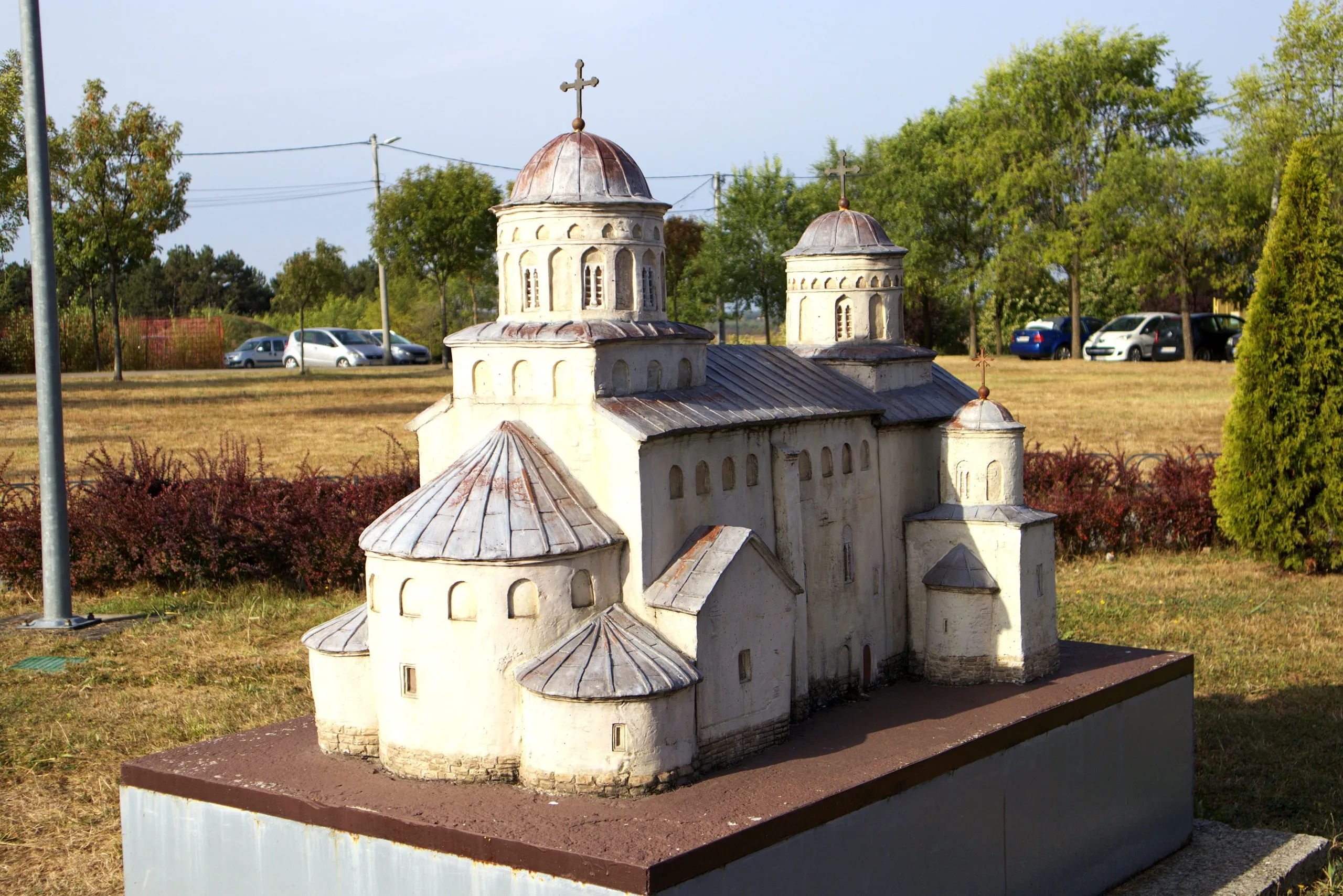
Mileševa
Monastery of the Ascension of Christ, endowment of King Vladislav and tomb of Saint Sava · Prijepolje
Mileševa was built in the third decade of the 13th century by King Vladislav, grandson of Stefan Nemanja. The relics of Saint Sava rested here, so the monastery became the centre of his cult. On its walls is the White Angel, one of the best-known frescoes in Serbian art.
How it looked when it was built
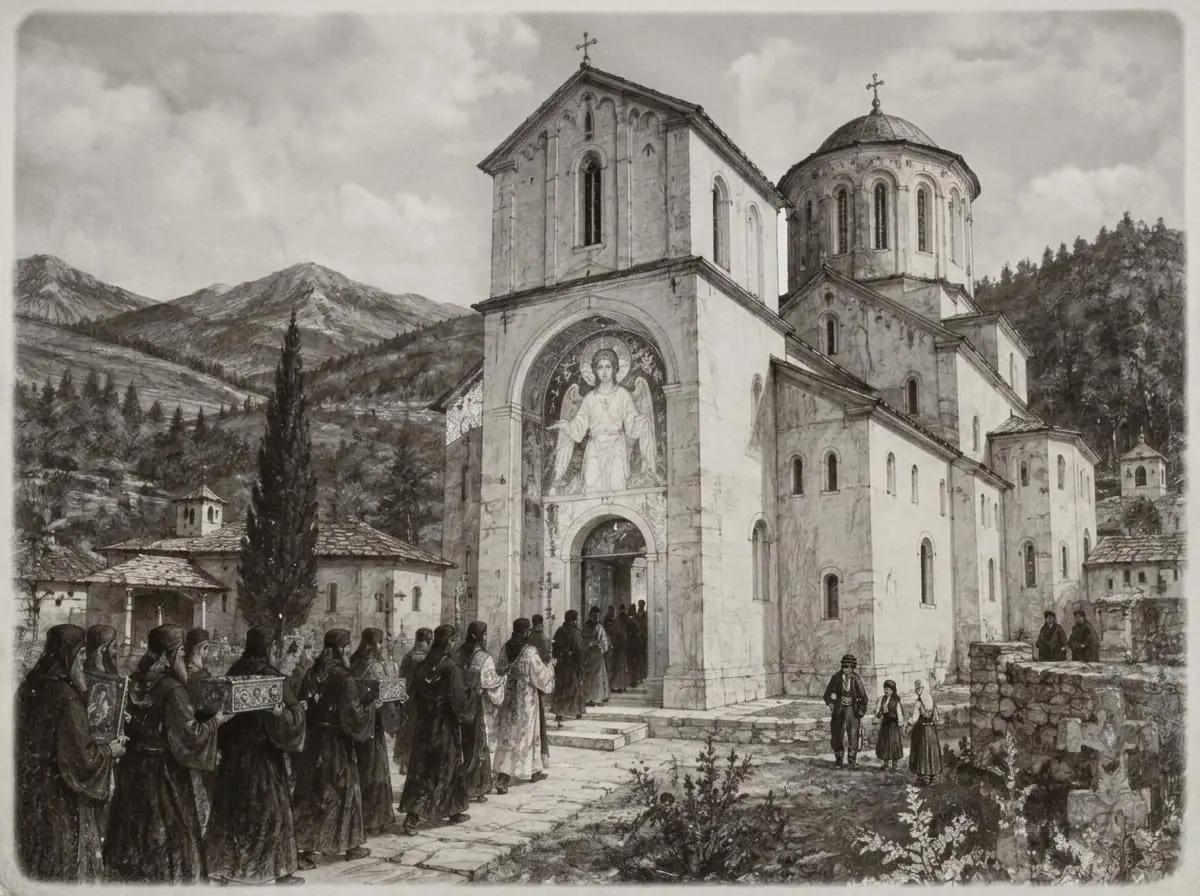
Miniature and original
Gallery
Drag the slider and compare the miniature with the real Mileševa near Prijepolje. Pay attention to the shape of the church and to the outer narthex that was added later.
History
In the canyon of the Mileševka river, not far from Prijepolje, stands a monastery that for centuries guarded the tomb of the most revered Serbian saint. The relics of Saint Sava were brought to Mileševa soon after his death. Although the Turks later burned them, Mileševa remained the place where he is remembered.
Read moreShow less
The monastery with the Church of the Ascension of Christ was built by Vladislav, son of King Stefan the First-Crowned and grandson of Stefan Nemanja. According to the Republic Institute for the Protection of Cultural Monuments, it was built in the third decade of the 13th century, and the frescoes in the church were painted before 1228. Vladislav began the building while he was still a prince, and his uncle, Archbishop Sava, played the decisive part in raising and painting the monastery. Vladislav was King of Serbia from 1234 to 1243 and is buried in Mileševa.
Sava died in 1235 in Tarnovo, in Bulgaria. Vladislav brought his uncle's relics to Mileševa. At that time an outer narthex with two side chapels was built onto the church and painted. Mileševa became the starting point of the cult of Saint Sava and one of the most important spiritual and artistic centres of the Serbian people.
The saint's tomb was held in such high regard that rulers of neighbouring lands were crowned here too. In 1377 Tvrtko I Kotromanić was crowned in Mileševa as King of Bosnia and Serbia. In 1446 Stefan Vukčić Kosača took the title “Herzog of Saint Sava”, from which Herzegovina later got its name.
Even under Turkish rule the monastery did not die out. In the 16th century a printing press worked here and published several liturgical books, and the wall paintings were restored in the 16th and 17th centuries. In 1594 the Turks carried Sava's relics off to Belgrade and burned them, in an attempt to break the spirit of the people. The monastery was damaged several times at the end of the 18th century and in the 19th century, and it was restored in the 1860s, when the appearance of the church was changed considerably. After the Second World War the frescoes were cleaned and conserved.
Mileševa is an immovable cultural property of exceptional importance. Today it is the seat of an eparchy of the Serbian Orthodox Church, and the sarcophagus of Saint Sava was restored in 2003.
People and events
Founder · reigned 1234–1243
King Stefan Vladislav
Son of Stefan the First-Crowned and grandson of Stefan Nemanja. He built Mileševa, brought the relics of his uncle Saint Sava there, and was buried there himself. His portrait, holding a model of the church in his hands, is considered a masterpiece of 13th-century art.Saint · c. 1175–1235
Saint Sava
The first archbishop of the independent Serbian church. He played the decisive part in the building of Mileševa. After his death in Tarnovo his relics were brought to Mileševa, which became the centre of his cult.King of Bosnia and Serbia · 14th century
Tvrtko I Kotromanić
Bosnian ruler who had himself crowned King of Bosnia and Serbia in Mileševa in 1377.Herzog of Saint Sava · 15th century
Stefan Vukčić Kosača
A nobleman who took the title “Herzog of Saint Sava” in Mileševa in 1446. The region he ruled was named Herzegovina after that title.Event · 1236/1237
Transfer of the relics of Saint Sava
King Vladislav brings his uncle's relics from Tarnovo to Mileševa.Event · 1377
Coronation of Tvrtko I
Tvrtko I Kotromanić is crowned King of Bosnia and Serbia in Mileševa.Event · 1446
Herzog of Saint Sava
Stefan Vukčić Kosača takes the title from which Herzegovina gets its name.Event · 1594
Burning of the relics
Sinan Pasha takes the relics of Saint Sava from Mileševa to Belgrade and burns them on Vračar.
From literature
Милешево слави се Телом Светог Саве Кога славе сви Срби С обе стране Саве; Синан-паша ватру пали Тело Светог Саве спали, Ал’ не спали славе, Нити спомен Саве.
This is one of the stanzas of the “Hymn to Saint Sava” (“Uskliknimo s ljubavlju”), in the version given in the church calendar of the Serbian Orthodox Church. In a few lines the stanza tells the whole story of Mileševa: the saint's body in the monastery, the pyre of 1594, and the memory that fire could not destroy.
Architecture
Raška school
The Church of the Ascension of Christ belongs to the Raška school. It has a single nave, an altar space divided into three parts, and a dome over the crossing of the nave and the choirs. The narthex was built at the same time as the church. Unlike older Raška churches, Mileševa is considerably wider on its eastern side than on its western side.
Around 1236 a two-storey outer narthex was added, with side chapels of Saint George and Saint Demetrius. During the restoration in the 19th century the narthex was raised and given a dome, and the shapes of the main dome and the windows were changed as well.
The frescoes of Mileševa are counted among the best European works of the 13th century. They were painted on a gold background, as if imitating mosaic. The most famous is the fresco of the Myrrhbearers at Christ's Tomb, with the White Angel. The Virgin from the Annunciation and the founder's composition with the portrait of King Vladislav are masterpieces too.
Where is the original
Prijepolje
Related monuments
Sources(5)
- Republički zavod za zaštitu spomenika kulture – Beograd, Manastir Mileševa (SK 161), Informacioni sistem nepokretnih kulturnih dobara, Republički zavod za zaštitu spomenika kulture (pristupljeno 4. 10. 2026), 2026
- Vikipedija (sr), Manastir Mileševa, Vikipedija na srpskom jeziku, revizija 31447336 (pristupljeno 4. 10. 2026), 2026
- Vikipedija (sr), Stefan Vladislav, Vikipedija na srpskom jeziku, revizija 30914308 (pristupljeno 4. 10. 2026), 2026
- Nepoznat autor, Himna Svetom Savi („Uskliknimo s ljubavlju“), strofa o Mileševi, Crkveni kalendar Srpske pravoslavne crkve 2015; tekst prema Vikizvorniku, revizija 136427
- Vikipedija (sr), Sveti Sava, Vikipedija na srpskom jeziku, revizija 31089418 (pristupljeno 4. 10. 2026), 2026