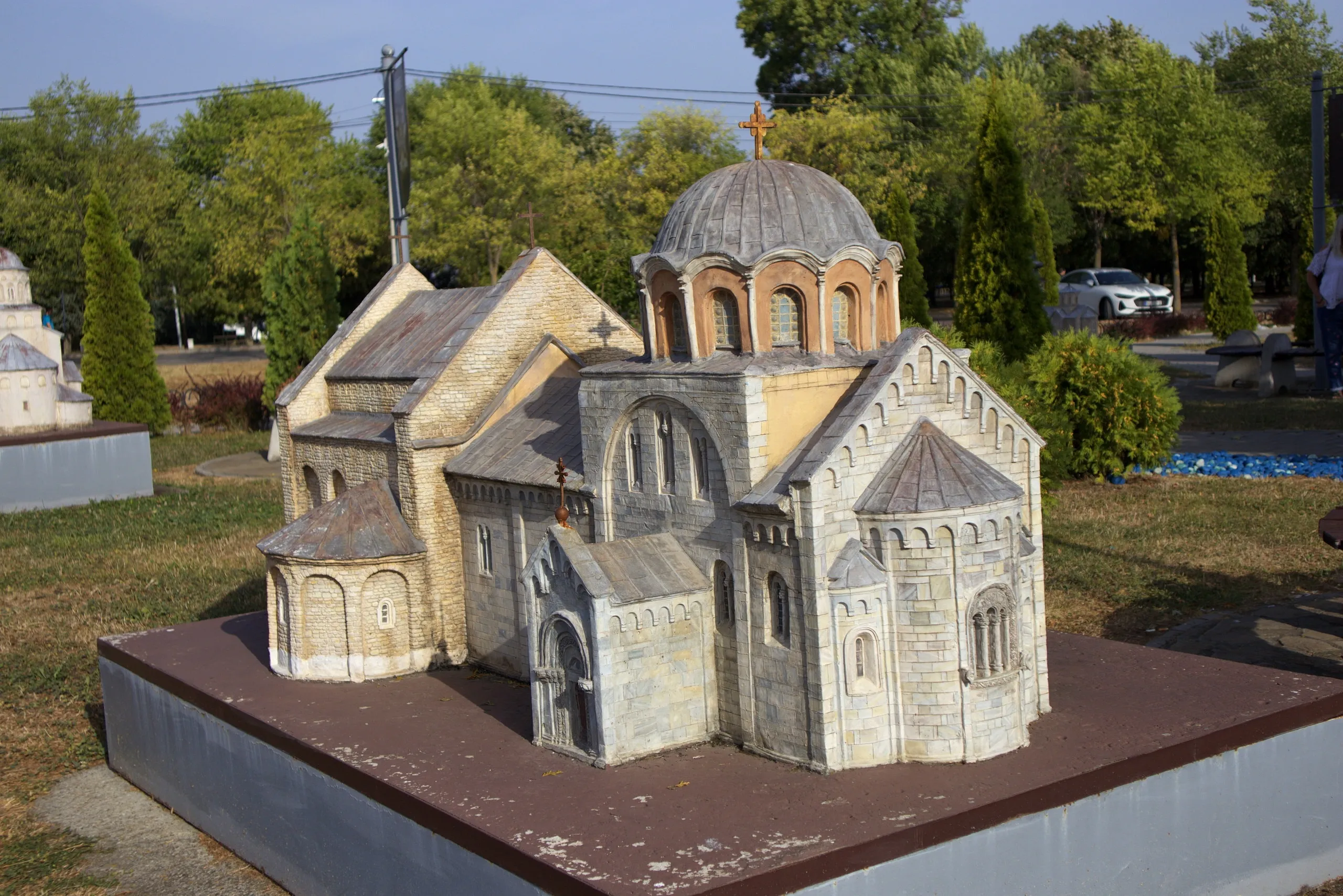
Studenica
Monastery of the Dormition of the Most Holy Mother of God, endowment and burial place of Stefan Nemanja · Kraljevo
Studenica was built at the end of the 12th century by Grand Župan Stefan Nemanja, forefather of the Nemanjić dynasty, as his endowment and burial place. The white marble Church of the Mother of God brings together Romanesque and Byzantine building. The monastery has been on the UNESCO World Heritage List since 1986.
How it looked when it was built
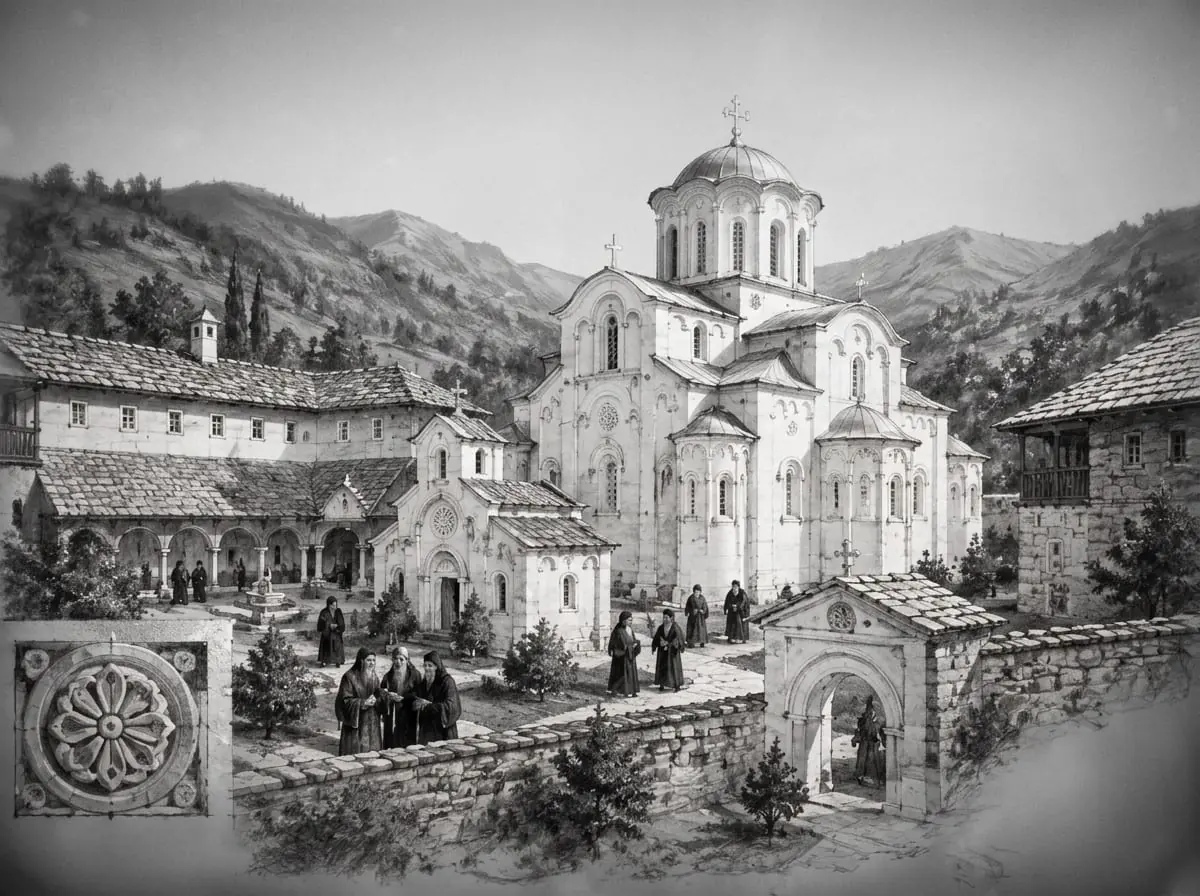
Miniature and original
Gallery
Drag the slider and compare the miniature with the real Studenica in the valley of the Studenica river. Look out for the white marble and for the decorated portals and windows.
History
In the forest on the slopes of Mount Golija, in a place that was once a hunting ground, Stefan Nemanja built the monastery where he wished to be laid to rest. It was here that his son Sava later brought his father's relics and wrote down the rules of monastic life. From the 12th century to this day, the monks of Studenica have never broken off their way of life.
Read moreShow less
Grand Župan Stefan Nemanja, forefather of the Nemanjić dynasty, began building Studenica at the end of the 12th century. The main church, dedicated to the Dormition of the Most Holy Mother of God, was under construction from 1186. When the work was finished, in the spring of 1196, Nemanja handed the throne to his son Stefan at a state assembly and withdrew to his endowment.
Soon afterwards he left for Mount Athos, where he became a monk under the name Simeon and where he died. In 1207 his youngest son, Sava, brought his father's relics from Hilandar to Studenica. Over their father's grave Sava reconciled his quarrelling brothers, Stefan and Vukan. Nemanja later came to be venerated as Saint Simeon the Myrrh-Streaming.
As abbot, around 1208, Sava wrote the Studenica Typikon, the rules by which the monastery's brotherhood lived. The first part of the Typikon is the life of the founder, Saint Simeon. Under Sava's care Studenica became the spiritual, cultural and medical centre of the Serbian state. Stefan and Vukan brought the finest painters, who decorated the Church of the Mother of God. The best-known fresco, the Crucifixion of Christ, is considered one of the greatest achievements of medieval art.
Other Nemanjić rulers left their mark on Studenica too. King Radoslav added the large narthex, and in 1314 King Milutin built the small Church of Saints Joachim and Anne, which people call the King's Church. Studenica served as a model for many rulers, who built their own burial churches after the example of the Church of the Mother of God.
After the fall of the Serbian Despotate in 1459, the Turks often attacked the monastery. The frescoes of the Church of the Mother of God were restored in 1569, but at the beginning of the 17th century a fire and an earthquake destroyed many documents and works of art. Restoration began in the 19th century, in the time of Prince Miloš, and after the Second World War the monument protection service restored the refectory, the residential quarters and the church's stone carving.
Studenica is an immovable cultural property of exceptional importance, and in 1986 UNESCO inscribed it on the World Heritage List. It lies 57 kilometres south of Kraljevo and belongs to the Eparchy of Žiča. Conservation work is carried out continuously.
People and events
Founder · c. 1113–1199
Stefan Nemanja (Saint Simeon)
Grand Župan of Serbia from 1166 to 1196 and forefather of the Nemanjić dynasty. He united almost all the Serbian lands into one state. He built Studenica as his endowment and burial place. He became a monk under the name Simeon, and the Serbian Orthodox Church celebrates him as Saint Simeon the Myrrh-Streaming.Abbot of Studenica · c. 1175–1235
Saint Sava
Nemanja's youngest son, born Rastko. As abbot of Studenica he brought his father's relics from Hilandar in 1207 and wrote the Studenica Typikon. In 1219 he became the first archbishop of the independent Serbian church.Heir and founder of the frescoes · c. 1166–1227
Stefan the First-Crowned
Nemanja's son, to whom his father handed the throne at Studenica in 1196. Together with his brother Vukan he brought the painters for the Church of the Mother of God. He is buried at Studenica.Founder of the King's Church · c. 1253–1321
King Milutin
Nemanja's great-grandson, King of Serbia from 1282 to 1321. In 1314 he built the Church of Saints Joachim and Anne, known as the King's Church, in the Studenica churchyard.Event · 1196
Assembly at Studenica
At a state assembly Nemanja hands the throne to his son Stefan and withdraws to the monastery.Event · 1207
Transfer of Nemanja's relics
Sava brings his father's relics from Hilandar to Studenica and reconciles the brothers Stefan and Vukan.Event · c. 1208
Studenica Typikon
Sava writes the rules of monastic life for the brotherhood of Studenica, with the life of Saint Simeon at the beginning.Event · 1314
The King's Church
King Milutin builds the Church of Saints Joachim and Anne in the churchyard.Event · 1986
World Heritage
UNESCO inscribes Studenica Monastery on the World Heritage List.
From literature
Прву јесам саградио цркву Студеницу испод Брвеника Родитељу цару Симеуну, Да се њему поје летурђија Без промене до суда страшнога;
In the folk poem “Saint Sava”, the lords gathered at an assembly in Kruševac wonder where Nemanja's treasure has gone. Sava answers that he spent it on endowments, and the first among them is Studenica. The poem changes history freely (the church was built by Nemanja himself), but it remembers what matters most: Studenica is an endowment built in memory of the forefather of the Nemanjić dynasty.
Architecture
Raška school
The Church of the Mother of God at Studenica is considered the beginning and the finest example of the Raška style, in which the Romanesque building of the West and the Byzantine building of the East come together. It was built by Romanesque masters from the Adriatic coast.
The church has a single nave with a dome. On the east is a three-sided apse, on the north and south are vestibules, and on the west is the large narthex added by King Radoslav. The facades are made of blocks of white marble, while the interior is lined with tufa (sedra). Around the portals and windows is the richest Romanesque stone carving in Serbian art. Beside the south portal is a sundial on which the shadow falls on letters instead of numbers.
The complex is surrounded by a defensive wall. Inside it are also the King's Church, the small Church of Saint Nicholas, the foundations of the Church of Saint John, the refectory and the residential quarters.
Where is the original
Kraljevo · UNESCO World Heritage
Related monuments
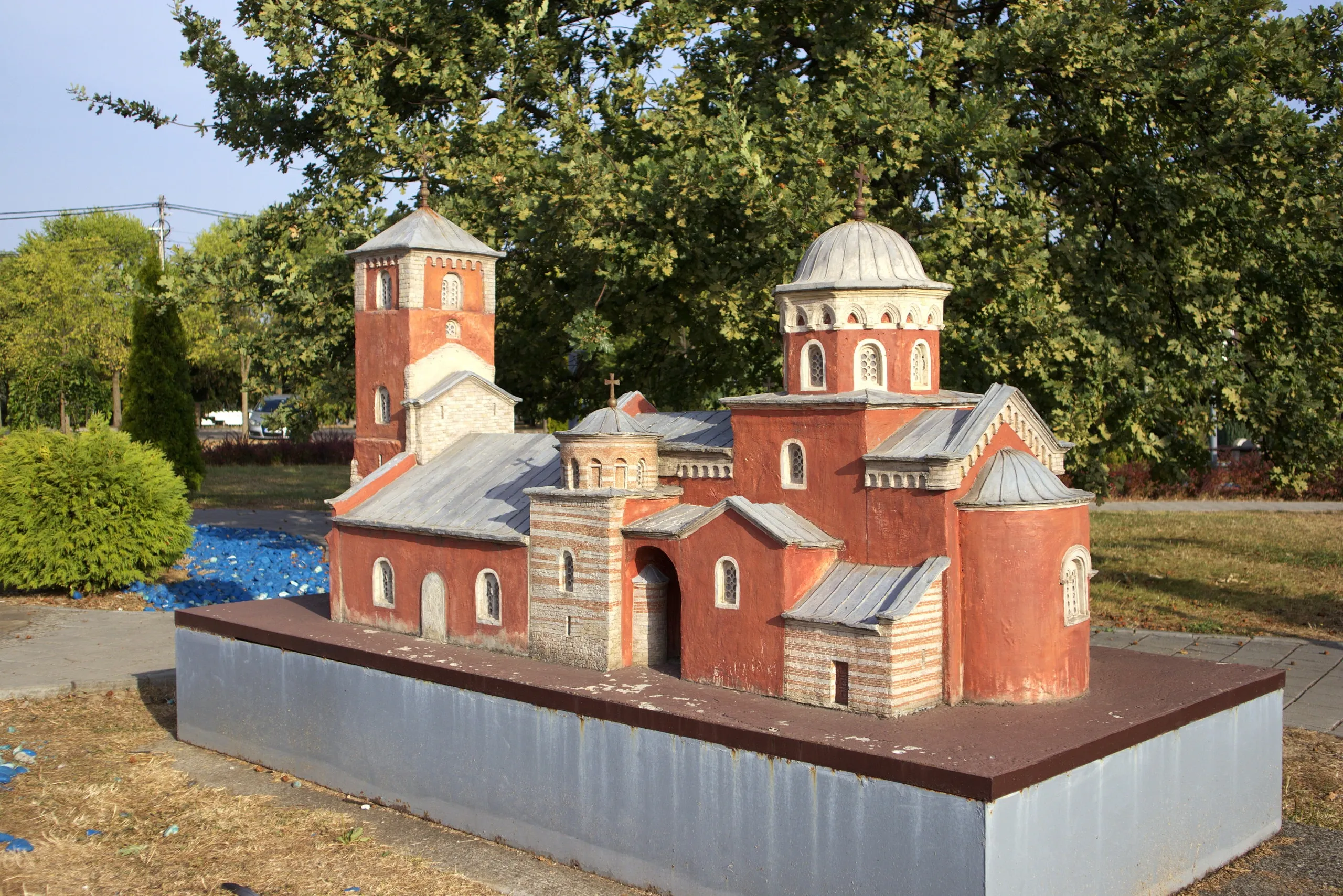
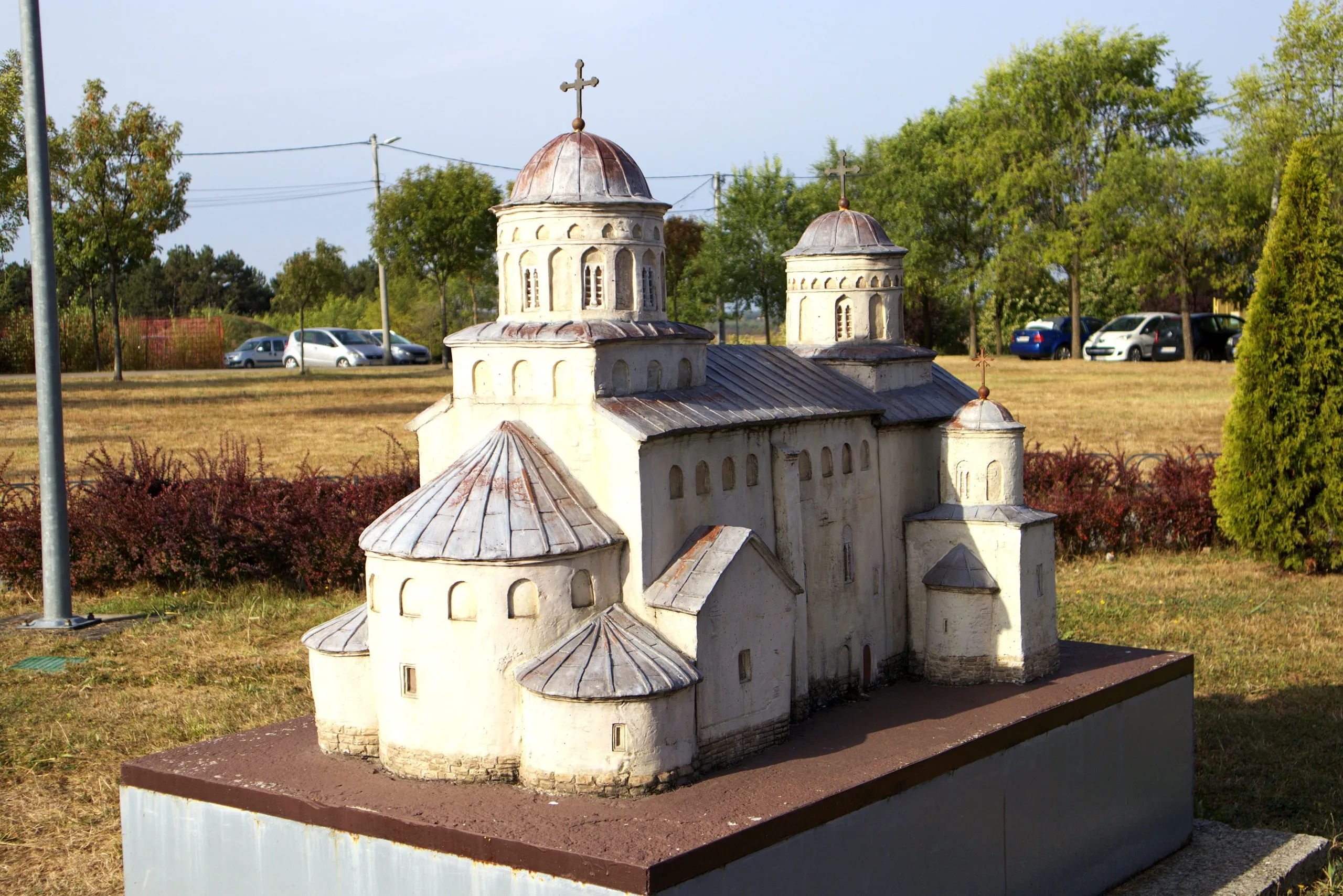
Sources(7)
- Republički zavod za zaštitu spomenika kulture – Beograd, Manastir Studenica (SK 158), Informacioni sistem nepokretnih kulturnih dobara, Republički zavod za zaštitu spomenika kulture (pristupljeno 4. 10. 2026), 2026
- Vikipedija (sr), Manastir Studenica, Vikipedija na srpskom jeziku, revizija 31732726 (pristupljeno 4. 10. 2026), 2026
- Vikipedija (sr), Stefan Nemanja, Vikipedija na srpskom jeziku, revizija 31719135 (pristupljeno 4. 10. 2026), 2026
- Vikipedija (sr), Sveti Sava, Vikipedija na srpskom jeziku, revizija 31089418 (pristupljeno 4. 10. 2026), 2026
- Narodna pesma, Sveti Savo, u: Srpske narodne pjesme iz neobjavljenih rukopisa Vuka Stef. Karadžića (SANU), Srpska akademija nauka i umetnosti; tekst prema Vikizvorniku, revizija 39751
- Vikipedija (sr), Stefan Nemanjić, Vikipedija na srpskom jeziku, revizija 31684135 (pristupljeno 4. 10. 2026), 2026
- Vikipedija (sr), Stefan Milutin, Vikipedija na srpskom jeziku, revizija 31740188 (pristupljeno 4. 10. 2026), 2026