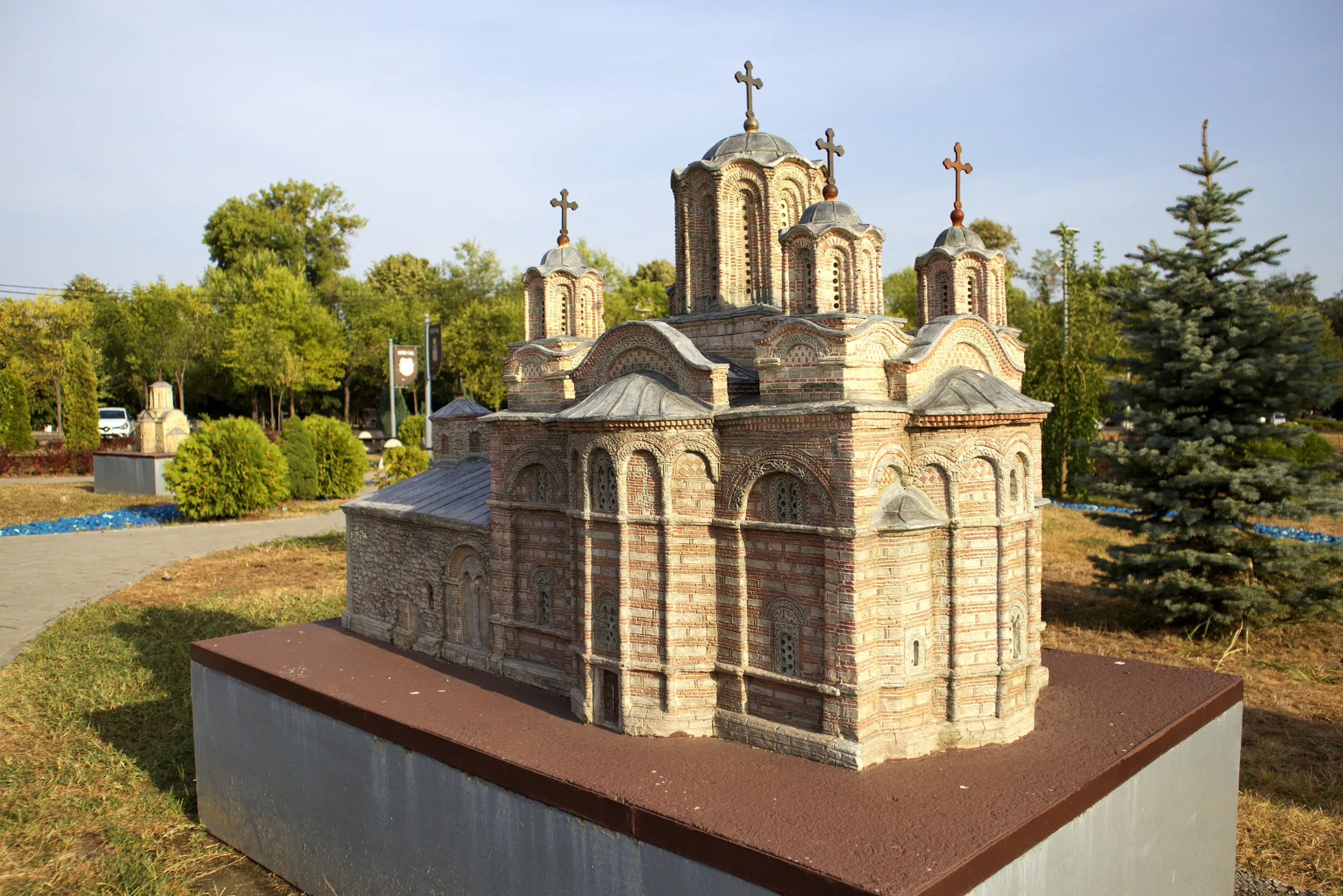
Ravanica
Monastery with the Church of the Ascension of Christ, endowment and burial church of Prince Lazar · Senje, Ćuprija
Prince Lazar built Ravanica near present-day Ćuprija as his endowment and burial church. Its Church of the Ascension is the first monument of the Morava style, and the relics of the holy prince, after three centuries of exile, have rested in it again since 1989.
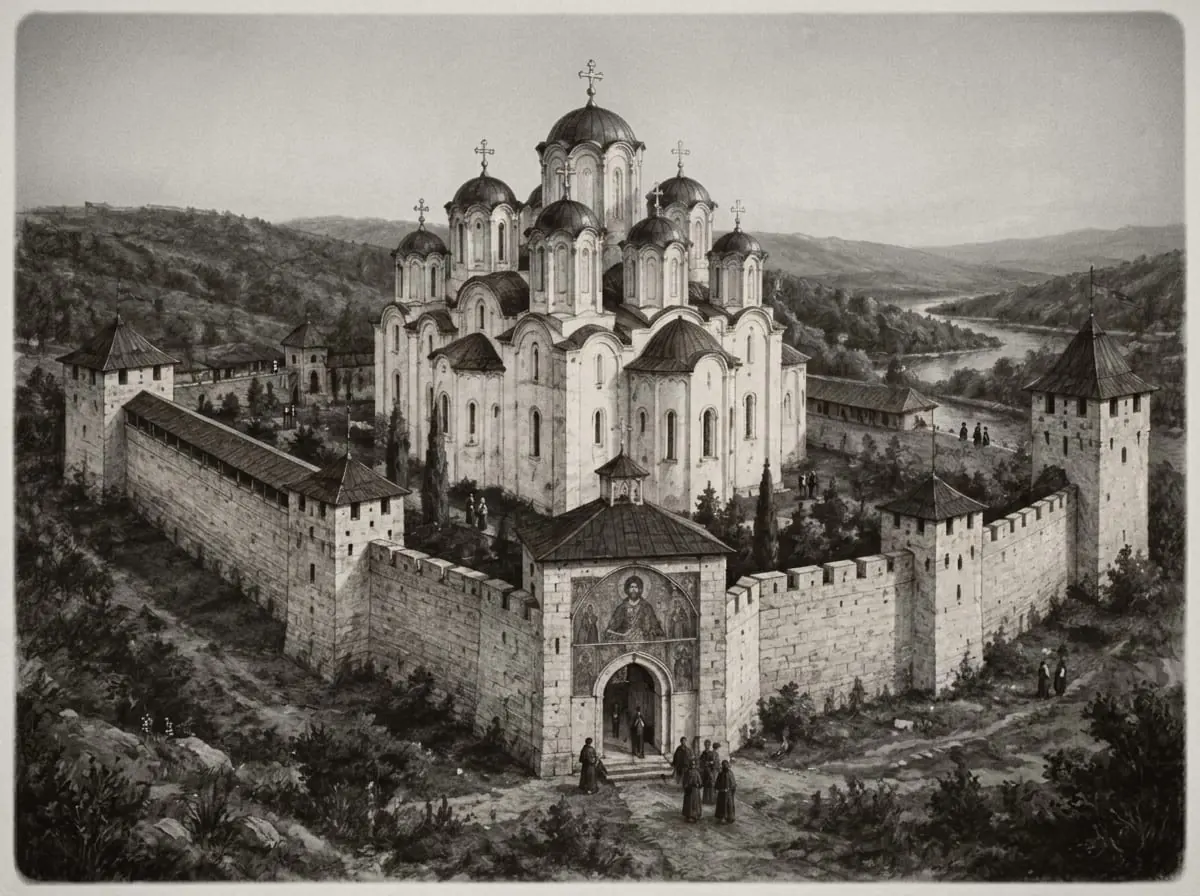
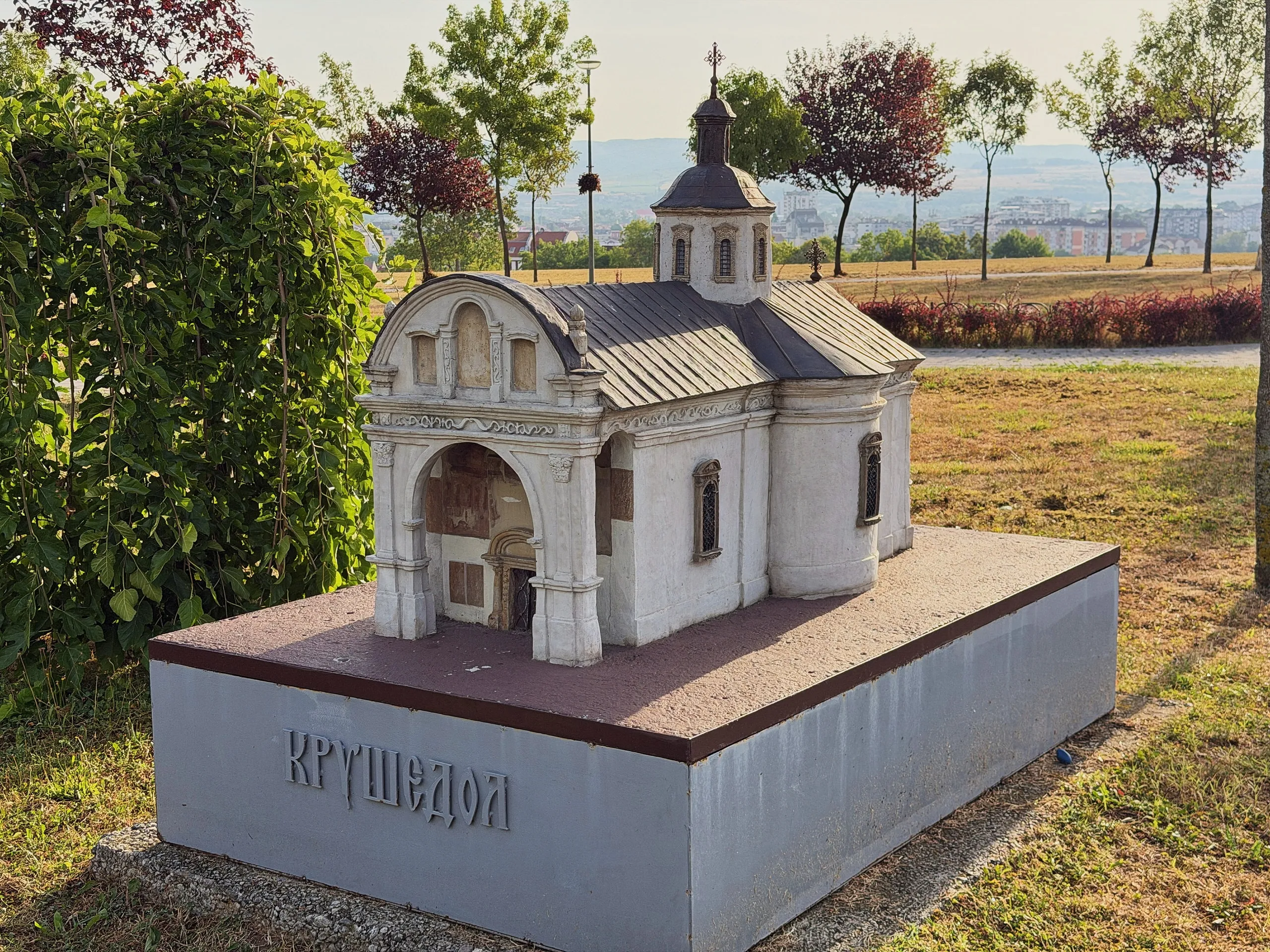
How it looked when it was built
Miniature and original
Gallery
Drag the slider and compare the miniature with the real Ravanica near Ćuprija. Count the domes and pay attention to the alternation of stone and brick.
History
At the foot of Kučaj, beside the little Ravanica river, Prince Lazar built the monastery in which he wished to be buried. After the Battle of Kosovo his relics were laid here, and from here the cult of the holy prince and the martyrs of Kosovo spread. In this way Ravanica became one of the most important shrines of the Serbian people.
Read moreShow less
After the Battle of Maritsa in 1371, Prince Lazar Hrebeljanović became the most powerful Serbian ruler. Like the Nemanjić rulers before him, he wanted to leave an endowment that would outlive him. He chose the valley of the little Ravanica river, at the foot of Mount Kučaj, not far from present-day Ćuprija.
According to a copy of the founding charter, work began between September 1376 and August 1377, and the charter was issued to the monastery in 1381, when the church was by all appearances finished. It is dedicated to the Ascension of Christ. The monastery is surrounded by a mighty wall with seven towers, and inside it there were also a refectory and monks' cells.
In the mid-1380s the church was painted with frescoes. After Lazar's death at Kosovo in 1389, an altered founder's composition was painted afterwards on the wall of the church. The prince's body was first buried in Priština and then solemnly brought to Ravanica. At the time of the transfer Lazar was proclaimed a saint.
For the next three centuries Ravanica was a place of pilgrimage. Then came the Great Migration. In the spring of 1690 the monks of Ravanica, fleeing Turkish revenge together with Patriarch Arsenije III, carried their founder's relics all the way to Szentendre above Buda. From there, in 1697, they took them to the Vrdnik monastery on Fruška Gora, which since then has also been called Sremska Ravanica.
The relics stayed in Vrdnik until 1942, when because of the Ustaše crimes they were moved to the Cathedral Church in Belgrade. Only on 9 September 1989, after 299 years, were they returned to his endowment, with great church celebrations. That year marked six centuries since the Battle of Kosovo.
Ravanica suffered damage more than once. The open narthex, added to the church at a later date, was destroyed in Turkish attacks; it was rebuilt and painted with frescoes between 1717 and 1729. In the second half of the 18th century the monastery was a stronghold of the rebels, so in April 1788 it was set on fire.
Conservation work on the architecture was carried out from 1956 to 1962, and on the wall paintings in 1964 and 1970. Today Ravanica is a convent of the Eparchy of Braničevo and an immovable cultural property of exceptional importance.
People and events
Founder · c. 1329–1389
Prince Lazar Hrebeljanović
Serbian prince, creator of the strongest Serbian state after 1371. He built Ravanica as his endowment and burial church, and he is shown with his family in the founder's composition. He was killed in the Battle of Kosovo, and when his relics were brought to Ravanica he was proclaimed a saint.Princess, founder · c. 1335–1405
Princess Milica
Lazar's wife, descended from the Nemanjić line. She is painted beside the prince and their sons in the founder's composition at Ravanica. After the Battle of Kosovo she ruled the state until her son Stefan grew up, and together with him she took care of Lazar's cult.Prince and despot · 1377–1427
Stefan Lazarević
Lazar's elder son and successor, whom his father marked out as heir to the throne while he was still a child. He is shown with his younger brother Vuk in the founder's composition at Ravanica.Patriarch of Peć · 1633–1706
Patriarch Arsenije III Crnojević
He led the Great Migration of the Serbs in 1690. The monks of Ravanica set off north with him too, carrying the relics of Prince Lazar.Event · 1376–1381
Building of Ravanica
Prince Lazar builds the Church of the Ascension and the fortified monastery; the charter is issued to the monastery in 1381. The Ravanica church is the first monument of the Morava style.Event · 1389
Battle of Kosovo
Prince Lazar is killed on Vidovdan. The founder's composition at Ravanica is completed after his death.Event · 1690
The Great Migration
The monks carry the relics of Prince Lazar to Szentendre, and in 1697 to Vrdnik on Fruška Gora.Event · 1989
Return of the relics
After 299 years, on 9 September, the relics of the holy prince are returned to Ravanica.
From literature
Да копамо мермера камена, Да градимо цркву од камена; И Турци ће царство преузети, И наше ће задужбине служит' Од вијека до суда Божијега
In the folk poem “Zidanje Ravanice” (“The Building of Ravanica”), Princess Milica reproaches Lazar for not building an endowment, as the Nemanjić rulers did. The prince intends to cover the church in gold and pearls, but Miloš Obilić advises him to build in stone, because the Turks will carry off the treasures, while the stone will remain.
Да видите славну Раваницу У Ресави ниже Параћина На студеној р'јеци Раваници, Задужбину нашег господара, Господара, славног кнез-Лазара
In the poem “Miloš u Latinima” (“Miloš among the Latins”), Miloš Obilić lists the Serbian monasteries that the Latins ought to admire. He remembers Ravanica as the endowment of his lord.
Architecture
Morava school
The Ravanica church is the first monument of Morava architecture. Its ground plan is a triconch (besides the altar apse on the east, there are two choir apses on the northern and southern sides) joined with a cross-in-square. Five domes rise above the church on pronounced cube-shaped bases: a large one in the middle and four smaller ones around it.
It is built of alternating rows of stone and brick. The facades are divided up by colonettes, niches and string courses, and decorated with ceramic ornament and exceptionally rich stone carving in low relief. Inside, Ravanica keeps the first wall paintings of the Morava school of painting, lyrical and decorative: in the domes Christ, the Virgin and the prophets, in the nave the Great Feasts, Christ's miracles and parables, holy warriors and monks.
Where is the original
Senje, Ćuprija
Related monuments
Sources(11)
- Republički zavod za zaštitu spomenika kulture – Beograd, Manastir Ravanica (SK 244), Informacioni sistem nepokretnih kulturnih dobara, Republički zavod za zaštitu spomenika kulture (pristupljeno 4. 10. 2026), 2026
- Branislav Vulović, Ravanica, njeno mesto i njena uloga u sakralnoj arhitekturi Pomoravlja – II. Istorija manastira Ravanice, Saopštenja VII, Republički zavod za zaštitu spomenika kulture, Beograd, 1966
- Janko Radovanović, Okrugli sto „Knez Lazar — istorija i tradicija“ u Kruševcu i Ćupriji (8—10. septembra 1989), Balcanica XXI, 373–374, Balkanološki institut SANU, Beograd, 1990
- Vikipedija (sr), Manastir Ravanica, Vikipedija na srpskom jeziku (pristupljeno 4. 10. 2026), 2026
- Republički zavod za zaštitu spomenika kulture – Beograd, Manastir Vrdnik – Ravanica (SK 1023), Informacioni sistem nepokretnih kulturnih dobara, Republički zavod za zaštitu spomenika kulture (pristupljeno 4. 10. 2026), 2026
- Vikipedija (sr), Lazar Hrebeljanović, Vikipedija na srpskom jeziku (pristupljeno 3. 10. 2026), 2026
- Vikipedija (sr), Milica Hrebeljanović, Vikipedija na srpskom jeziku (pristupljeno 3. 10. 2026), 2026
- Vikipedija (sr), Stefan Lazarević, Vikipedija na srpskom jeziku (pristupljeno 3. 10. 2026), 2026
- Vikipedija (sr), Moravski stil, Vikipedija na srpskom jeziku (pristupljeno 3. 10. 2026), 2026
- Vuk Stefanović Karadžić (sakupio i izdao), Zidanje Ravanice, u: Srpske narodne pjesme, knjiga druga, Beč; tekst prema Vikizvorniku, revizija 79993, 1845
- Vuk Stefanović Karadžić (sakupio i izdao), Miloš u Latinima, u: Srpske narodne pjesme, knjiga druga, Tekst prema Vikizvorniku, revizija 15152