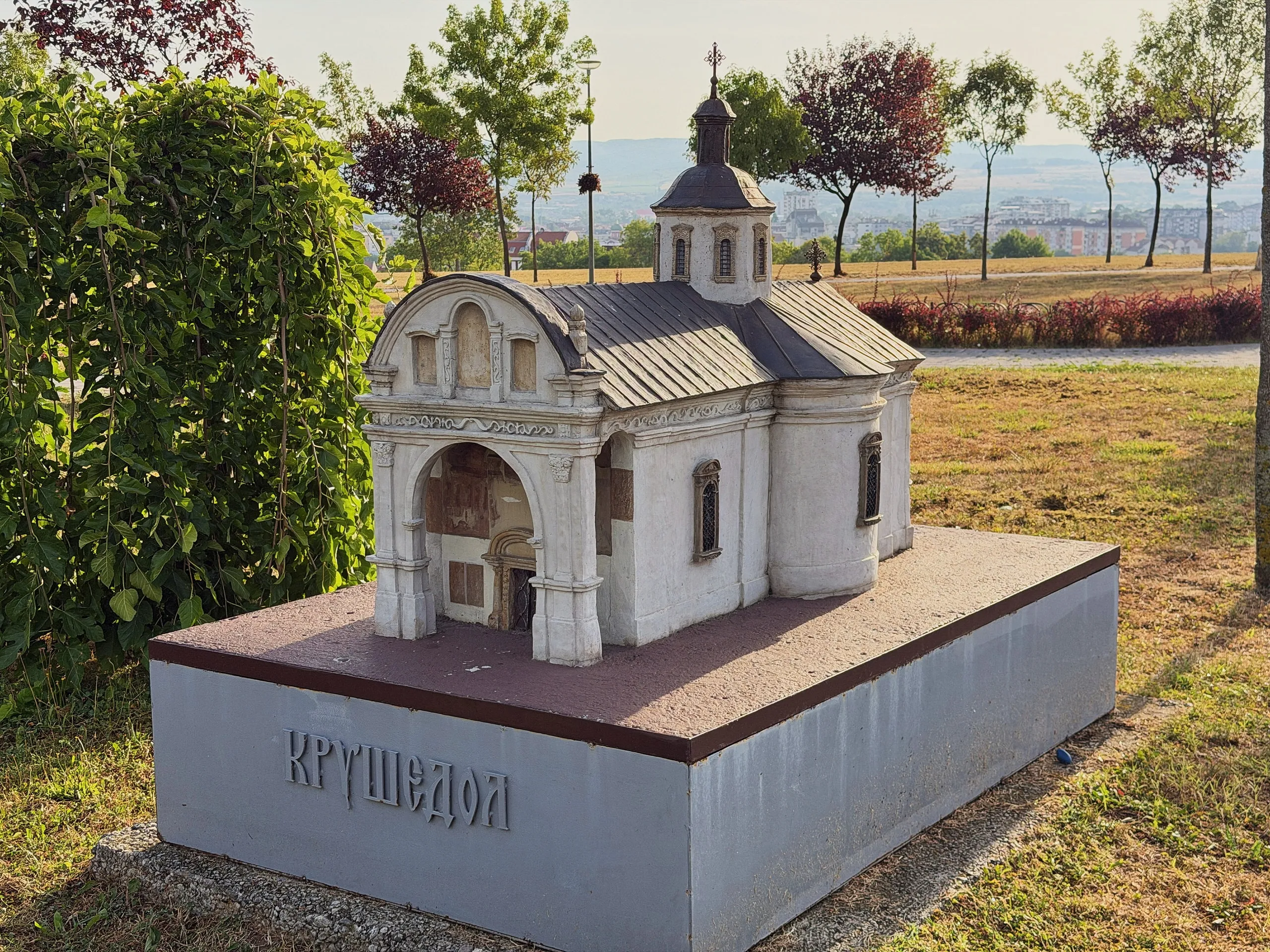
Krušedol
Monastery with the Church of the Annunciation, endowment and mausoleum of the last Branković family · Krušedol Prnjavor, Fruška Gora
Krušedol on Fruška Gora was built between 1509 and 1516 by Bishop Maksim, the last of the Branković line of despots, as the burial church of his family. Burned in 1716, it was restored in the Baroque spirit and became the most distinguished monastery of Fruška Gora.
How it looked when it was built
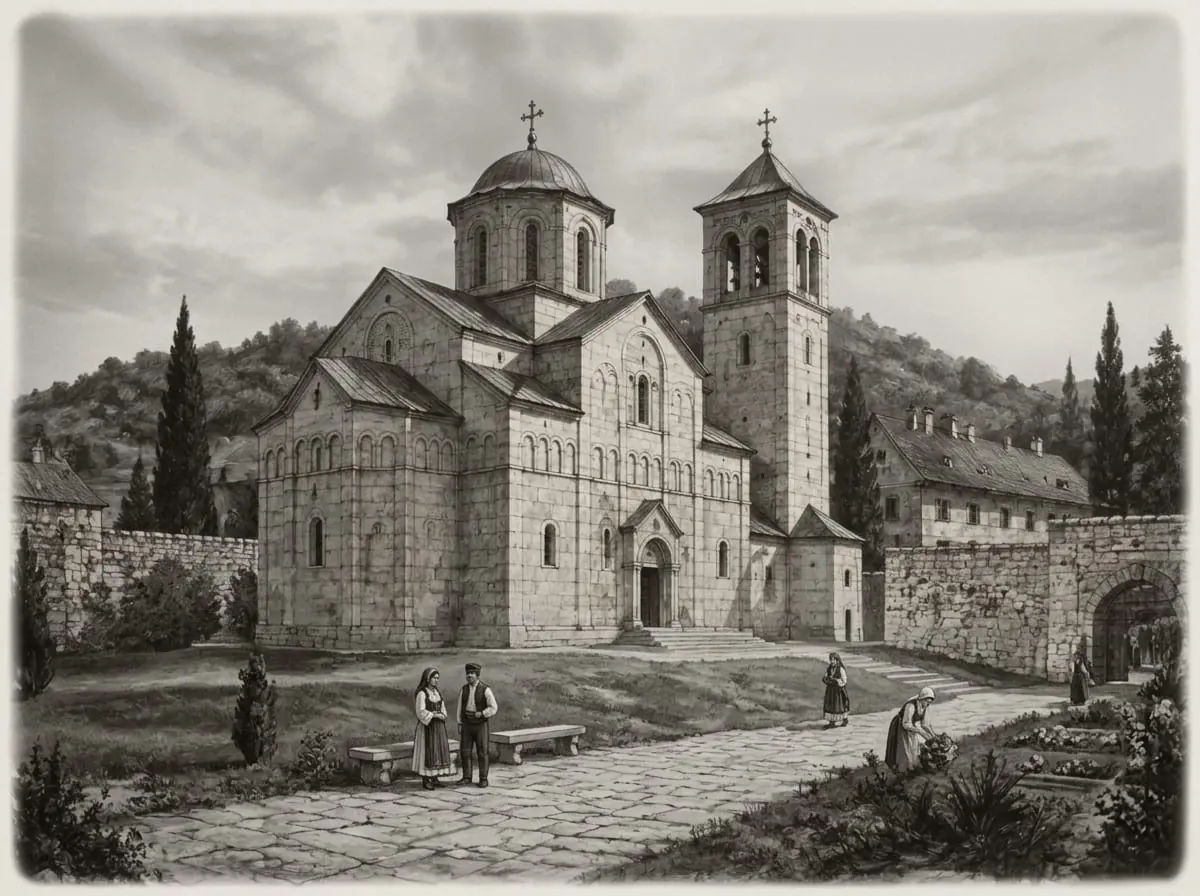
Miniature and original
Gallery
Drag the slider and compare the miniature with the real Krušedol on Fruška Gora. Pay attention to the Baroque bell tower and the dome.
History
When the medieval Serbian state had already disappeared, its last despots found refuge north of the Danube, in Srem. One of them, Đorđe Branković, became a monk and then Bishop Maksim, and built Krušedol on the south-eastern slopes of Fruška Gora. The monastery became the grave of the last Brankovićs, and later of many notable Serbs as well.
Read moreShow less
Angelina, the widow of the blind despot Stefan Branković, lived with her sons Đorđe and Jovan under the protection of Emperor Frederick in Vienna. In the mid-1480s the Hungarian king Matthias appointed Đorđe Serbian despot, and the Brankovićs were given estates in Srem. Unhappy in his marriage, Đorđe gave up the title of despot in 1496 and became a monk under the name Maksim. His brother Jovan became despot, and he died in 1502.
Two years later Maksim and his mother Angelina had to leave their estates in Srem. Taking the relics of his father and brother, they went to Wallachia, to the ruler there.
When he returned to Srem, between 1509 and 1516, Bishop Maksim built the Krušedol monastery, with a church dedicated to the Annunciation. His greatest help in this came from a friend, the Wallachian voivode Jovan Njegoje Basaraba, who came to the throne in 1512, and part of the donation, by all appearances, was also given by his mother Angelina. The historian Vladimir Ćorović called Krušedol “the endowment and resting place of the last Serbian despots”. Maksim died in Krušedol on 18 January 1516, and with him the despot line of the Brankovićs died out. The people and the Church began to honour the Brankovićs as a holy family line.
The monastery suffered much destruction. The worst came in 1716, when the Turks burned it and scattered the relics of the Brankovićs. Restoration began in 1722 and lasted until the middle of the 18th century. That was when Krušedol took on its present Baroque look: a tall bell tower north-west of the church, begun in 1726, and a spacious open porch along the west front, added in 1745. From 1750 to 1756 the narthex, the nave and the altar were painted.
After the death of Patriarch Arsenije III, in 1708, Krušedol was chosen as the seat of the Serbian metropolitanate in Hungary, and the first national assemblies were held there too. The metropolitans, however, soon began to live in Karlovci. Many notable people of Serbian history are buried in Krušedol: Patriarch Arsenije III Crnojević, who led the Great Migration of 1690, Princess Ljubica Obrenović and King Milan Obrenović.
In the Second World War the monastery was plundered and badly damaged. Today, by its rank among the Fruška Gora monasteries and by the wealth of its treasury, it is one of the most important. It is an immovable cultural property of exceptional importance.
People and events
Founder · c. 1461–1516
Bishop Maksim (Đorđe Branković)
Son of the blind despot Stefan Branković and Angelina. As Đorđe he held the title of Serbian despot in Hungary, and in 1496 he became a monk and later a metropolitan. He built Krušedol and the Staro Hopovo monastery. He died in Krušedol on 18 January 1516, as the last of the despot line of the Brankovićs.Founder · 15th–16th century
Despotess Angelina
Widow of Despot Stefan Branković and mother of Đorđe (Maksim) and Jovan. According to Ćorović, she probably gave part of the donation for the building of Krušedol. The folk poem “The Death of Jovo Despotović” remembers her as Mother Anđelija.Benefactor · 16th century
Jovan Njegoje Basaraba
Wallachian voivode from 1512, a friend of Bishop Maksim and a patron of the arts, founder of the Argeș monastery. It was mainly with his help that Krušedol was built.Patriarch of Peć · 1633–1706
Patriarch Arsenije III Crnojević
He led the Great Migration of the Serbs in 1690. He is buried in Krušedol.Event · 1509–1516
Building of Krušedol
Bishop Maksim, with the help of the Wallachian voivode and his mother Angelina, builds the monastery as the tomb of the Brankovićs.Event · 1716
Burning of the monastery
The Turks burn Krušedol, and the relics of the Brankovićs are scattered.Event · 1722–1756
Baroque restoration
The bell tower and the porch are built, and the church receives new wall paintings (1750–1756).
From literature
Његовом помоћу, углавном, сазидао је владика Максим манастир Крушедол. То је задужбина и покојиште последњих српских деспота.
This is how the historian Vladimir Ćorović described Krušedol in 1933, referring to the help of the Wallachian voivode Jovan Njegoje Basaraba.
Пак ти трчи, штогођ брже можеш, Крушедолу б'јелу манастиру, Те ми зовни мог рођеног брата, Мога брата, Максима владику
In the folk poem “The Death of Jovo Despotović” the sick Jovan, the younger brother of Bishop Maksim, sends a servant to “white” Krušedol to fetch his brother, and tells his mother Anđelija that he is getting ready for a long journey, so as not to sadden her.
Architecture
Other style
The church of Krušedol has a trefoil, triconch plan: semicircular apses vaulted with semi-domes, an elongated nave and a narthex. The vaults are barrel vaults, and the octagonal dome rests on four piers. Today the medieval core is wrapped in Baroque dress from the 18th century.
The most striking features are the tall Baroque bell tower north-west of the church and the spacious open porch along the west front. Inside, the Baroque wall paintings from 1750–1756 are attributed to the Ukrainian painter Jov Vasilijevič (narthex and altar) and to Stefan Tenecki (nave). On the west façade and on the piers, fragments of wall paintings from the middle of the 16th century have survived. The iconostasis is dominated by a monumental cross with the Crucifixion.
Where is the original
Krušedol Prnjavor, Fruška Gora
Related monuments
Sources(5)
- Republički zavod za zaštitu spomenika kulture – Beograd, Manastir Krušedol (SK 1040), Informacioni sistem nepokretnih kulturnih dobara, Republički zavod za zaštitu spomenika kulture (pristupljeno 4. 10. 2026), 2026
- Vladimir Ćorović, Istorija Jugoslavije, treći period, XII. Poslednji Brankovići i despoti Berislavići, Narodno delo, Beograd; tekst prema Vikizvorniku, revizija 49209, 1933
- Vladimir Ćorović, Istorija Jugoslavije, četvrti period, poglavlje 19, Narodno delo, Beograd; tekst prema Vikizvorniku, revizija 49231, 1933
- Vikipedija (sr), Manastir Krušedol, Vikipedija na srpskom jeziku (pristupljeno 4. 10. 2026), 2026
- Narodna pesma, Smrt Jova Despotovića, Tekst prema Vikizvorniku, revizija 75758