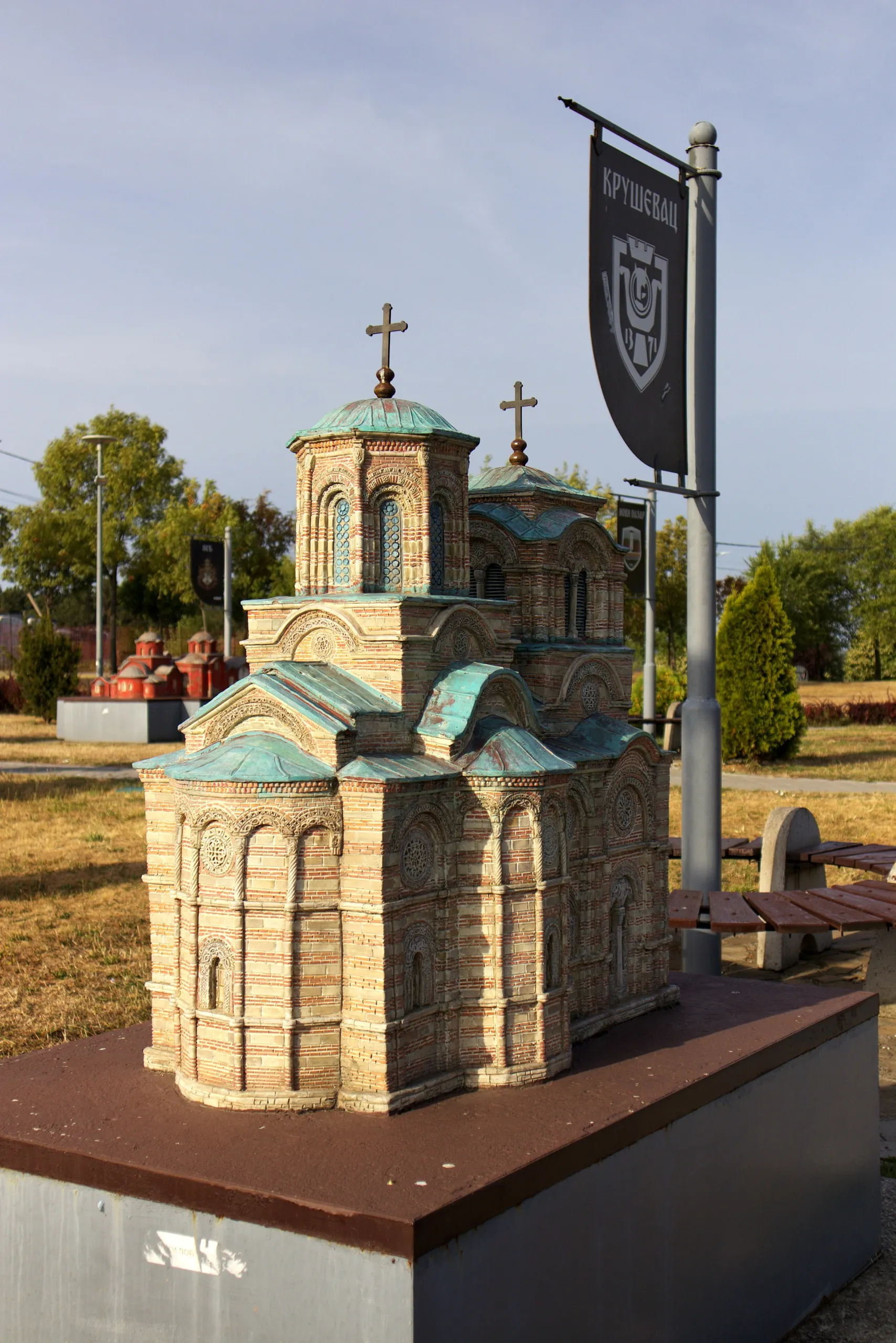
Lazarica
Church of Saint Stephen the Protomartyr, the court church of Prince Lazar · Kruševac
Lazarica is the court church that Prince Lazar built around 1377–1380 in his new capital, Kruševac. Stone rosettes, interlace ornament and a façade of stone and brick make it one of the first monuments of the Morava style.
How it looked when it was built
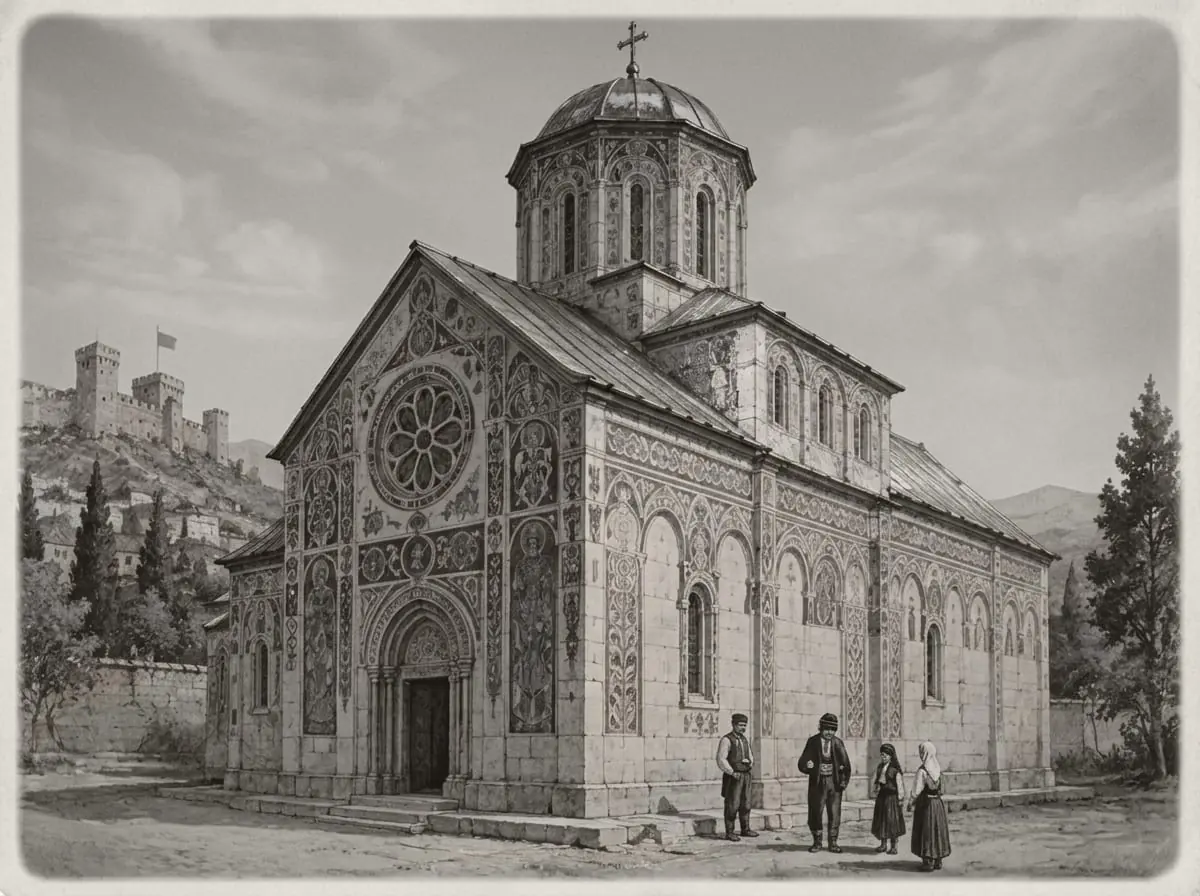
Miniature and original
Gallery
Drag the slider and compare the miniature with the real Lazarica in the centre of Kruševac. Pay attention to the alternating stone and brick and to the rosettes in the upper band of the façade.
History
More than six centuries ago Prince Lazar built a new capital, Kruševac, and in it, next to his court, a church dedicated to Saint Stephen the Protomartyr. The people named it Lazarica after its founder. It survived Turkish rule and amateur repairs, and then one of the first scientific restorations in Serbia.
Read moreShow less
After the Battle of Maritsa in 1371 the Serbian Empire broke up into the lands of individual lords. Among them, Prince Lazar Hrebeljanović gradually created the strongest state, in the basin of the Great, West and South Morava rivers. Its seat became Kruševac, a new fortified town.
Inside the walls of that town, around 1377–1380, the prince built his court church. It was not a monastery church, but a church where the ruler prayed with his family and court. Most probably in that very year, 1377, Lazar's son and heir Stefan was born in Kruševac, and he was named in keeping with the tradition of the Nemanjić line.
Together with Ravanica, Lazar's endowment near Ćuprija, Lazarica marks the beginning of a new direction in building: the Morava style. Soon after it the church of the Cozia monastery was built, which is in a certain sense a copy of it and, by all appearances, the work of the same master builders.
On Vidovdan, 15 June 1389 by the Julian calendar (28 June by today's), Prince Lazar was killed in the Battle of Kosovo against the army of Sultan Murad I. His relics were moved to Ravanica in 1391. Until Stefan grew up, the state was governed by Princess Milica. Lazar was soon proclaimed a saint, and in folk tradition he has been remembered as Tsar Lazar.
During Turkish rule the church suffered damage. There are no traces of the original frescoes: by all appearances, the church was painted only in 1737–1740 by the painter (zograf) Andra Andrejević with his company, and only fragments of that painting have survived. The iconostasis from 1844, probably the work of the painter Živko Pavlović, is preserved in full.
After the liberation of Kruševac, during the 19th century, several amateur renovations were carried out on the church. Its original appearance was given back to it by the architect Pera J. Popović, through pioneering conservation and restoration work from 1904 to 1908, based on scientific principles.
Protective work on the architecture and conservation of the iconostasis were carried out in 1989. Today Lazarica, together with the Kruševac Fortress, is an immovable cultural property of exceptional importance. It stands in the very centre of Kruševac, and in the same complex you can also see the remains of Lazar's fortification with its donjon tower.
People and events
Founder · c. 1329–1389
Prince Lazar Hrebeljanović
The Serbian prince who, after 1371, created the most important state on the soil of the former Serbian Empire, with its capital in Kruševac. He built Lazarica and Ravanica, where his relics are kept today. He was killed in the Battle of Kosovo and soon afterwards proclaimed a saint. The people remember him as Tsar Lazar.Princess, ruler, nun · c. 1335–1405
Princess Milica
Lazar's wife, descended from the Nemanjić line. After Lazar's death she governed the state until her son Stefan grew up. She founded the Ljubostinja monastery, where she became a nun under the name Evgenija and where she is buried. She also wrote literary works, among them “A Mother's Prayer”. The Serbian Orthodox Church celebrates her as a saint.Prince and despot · 1377–1427
Stefan Lazarević
Son of Prince Lazar and Princess Milica, most probably born in Kruševac. He ruled as prince (1389–1402) and then as despot (1402–1427). He was considered one of the best knights of his time and was a writer. In 1405 he moved the capital to Belgrade, whose fortress he rebuilt.Poet · c. 1350 – after 1405
The nun Jefimija
Before becoming a nun she was Jelena, widow of Despot Uglješa Mrnjavčević, who was killed in the Battle of Maritsa. She lived at Lazar's court. In gold thread on red silk she embroidered the “Praise to Prince Lazar”, one of the most important poetic works of the Serbian Middle Ages.Painter (zograf) · 18th century
Andra Andrejević
The painter who, with his company, by all appearances was the first to paint the interior of Lazarica, in 1737–1740. Only fragments of those wall paintings have survived to this day.Architect and restorer · 1873–1945
Pera J. Popović
A Serbian architect, heraldist and vexillologist. From 1904 to 1908 he led the work that gave Lazarica back its original appearance, the first professional conservation and restoration project in Serbia.Event · c. 1377–1380
Building of Lazarica
Prince Lazar builds the court church of Saint Stephen inside the walls of the new town of Kruševac. Together with Ravanica, it marks the beginning of the Morava style.Event · 1389
Battle of Kosovo
On Vidovdan, 15 (28) June, not far from Priština, the Serbian army under Prince Lazar clashed with the Ottoman army of Sultan Murad I. Both the prince and the sultan were killed in the battle.Event · 1391
Transfer of the relics to Ravanica
The relics of Prince Lazar were moved from Priština to his endowment, Ravanica.Event · 1737–1740
The first wall paintings
The painter (zograf) Andra Andrejević and his company paint the church; only fragments have survived.Event · 1904–1908
Restoration by Pera J. Popović
A pioneering, scientifically grounded project gives the church back its original appearance after the amateur renovations of the 19th century.
From literature
Славу слави српски кнез Лазаре У Крушевцу мјесту скровитоме.
This is how “The Prince's Supper”, from Vuk's collection of folk poems, begins. In the poem, the last supper on the eve of the Battle of Kosovo takes place right in Kruševac, Lazar's town: at the table the prince raises a toast to Miloš Obilić and doubts his loyalty, and Miloš swears that tomorrow, on Vidovdan, he will show who is faithful and who is faithless.
И тако две жеље постигао јеси: и змију убио јеси и мучења венац примио јеси од Бога.
These words were embroidered by the nun Jefimija, who lived at Lazar's court, in gold thread on red silk, as a pall for the coffin holding the prince's relics. And so, less than fifteen years after Kosovo, Lazar became a “new martyr” in literature.
Architecture
Morava school
Lazarica is one of the first buildings of the Morava style. Its plan is a trefoil, a triconch of the compact type: besides the altar apse on the east, there are two more semicircular choir apses on the north and south sides. The church has three bays and a dome over the middle one. On the west is the narthex, which originally had three entrances; the side ones were later walled up. Above the narthex rises a bell tower with a katechoumenon and a chapel on the upper floor.
It is built in the “Byzantine manner”: a row of cut stone blocks alternates with three rows of red brick, and the wide mortar joints deliberately stand out from the plane of the wall. The side walls and the apses are divided into vertical fields that end in arches, and two string courses divide the façade horizontally into three zones. In the highest zone are the stone rosettes, each one different, on a background of red and yellow fields arranged as on a chessboard. Around the windows in the zone below them runs a stone interlace. It is these interlace patterns and pierced rosettes that are the most striking decoration of the church.
Where is the original
Kruševac
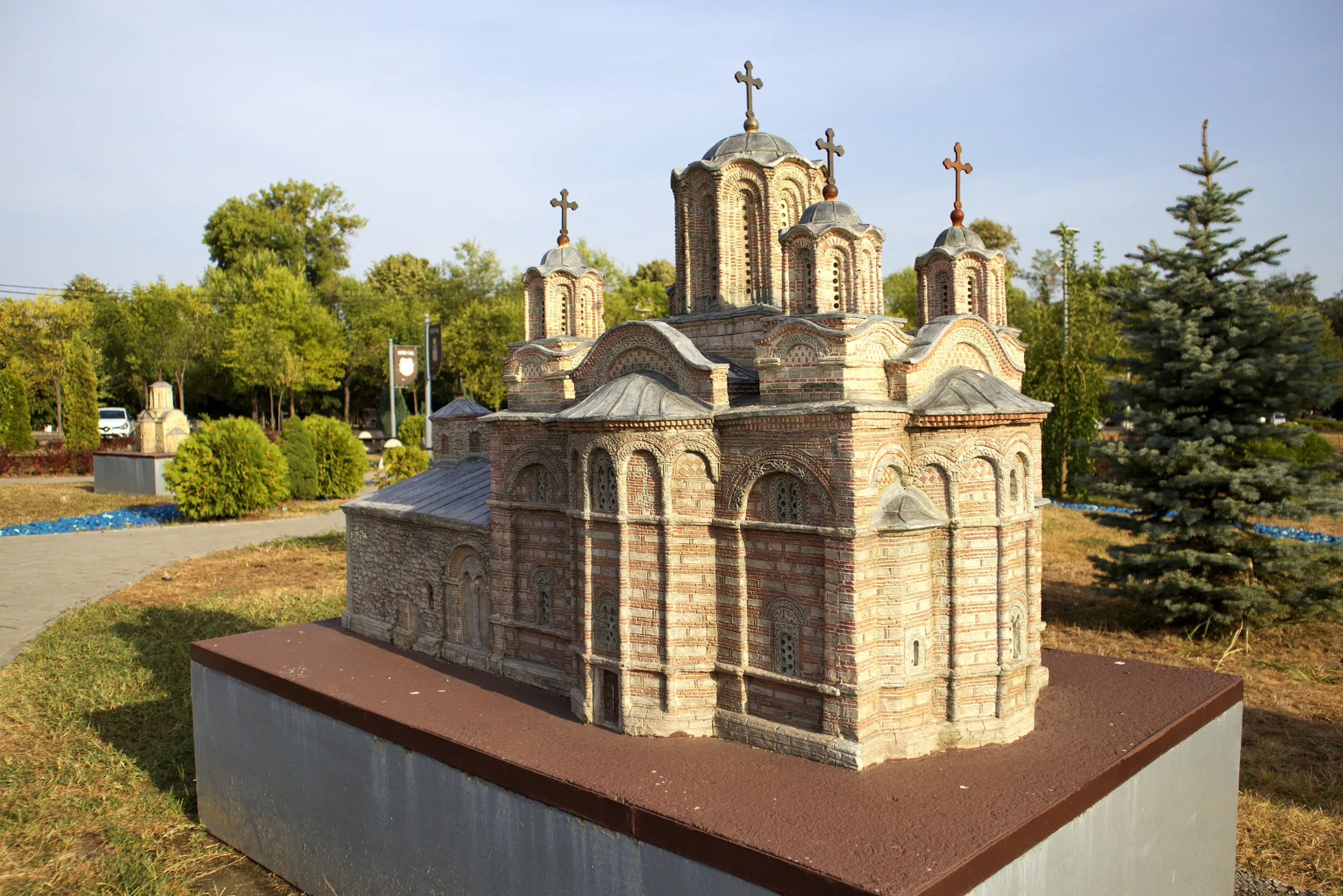
Related monuments
Sources(11)
- Republički zavod za zaštitu spomenika kulture – Beograd, Crkva Lazarica (SK 157), Informacioni sistem nepokretnih kulturnih dobara, Republički zavod za zaštitu spomenika kulture (pristupljeno 3. 10. 2026), 2026
- Vikipedija (sr), Crkva Svetog prvomučenika Stefana u Kruševcu, Vikipedija na srpskom jeziku (pristupljeno 3. 10. 2026), 2026
- Vikipedija (sr), Moravski stil, Vikipedija na srpskom jeziku (pristupljeno 3. 10. 2026), 2026
- Vikipedija (sr), Lazar Hrebeljanović, Vikipedija na srpskom jeziku (pristupljeno 3. 10. 2026), 2026
- Vikipedija (sr), Milica Hrebeljanović, Vikipedija na srpskom jeziku (pristupljeno 3. 10. 2026), 2026
- Vikipedija (sr), Stefan Lazarević, Vikipedija na srpskom jeziku (pristupljeno 3. 10. 2026), 2026
- Vikipedija (sr), Kosovska bitka, Vikipedija na srpskom jeziku (pristupljeno 3. 10. 2026), 2026
- Vikipedija (sr), Pohvala knezu Lazaru, Vikipedija na srpskom jeziku (pristupljeno 3. 10. 2026), 2026
- Vikipedija (sr), Petar Popović (arhitekta), Vikipedija na srpskom jeziku (pristupljeno 3. 10. 2026), 2026
- Jefimija, Pohvala svetom knezu Lazaru (prevod na savremeni srpski jezik), Vikizvornik, revizija 138206, 1402
- Vuk Stefanović Karadžić (sakupio i izdao), Kneževa večera, u: Srpske narodne pjesme, knjiga druga, Beč; tekst prema Vikizvorniku, revizija 145436, 1845