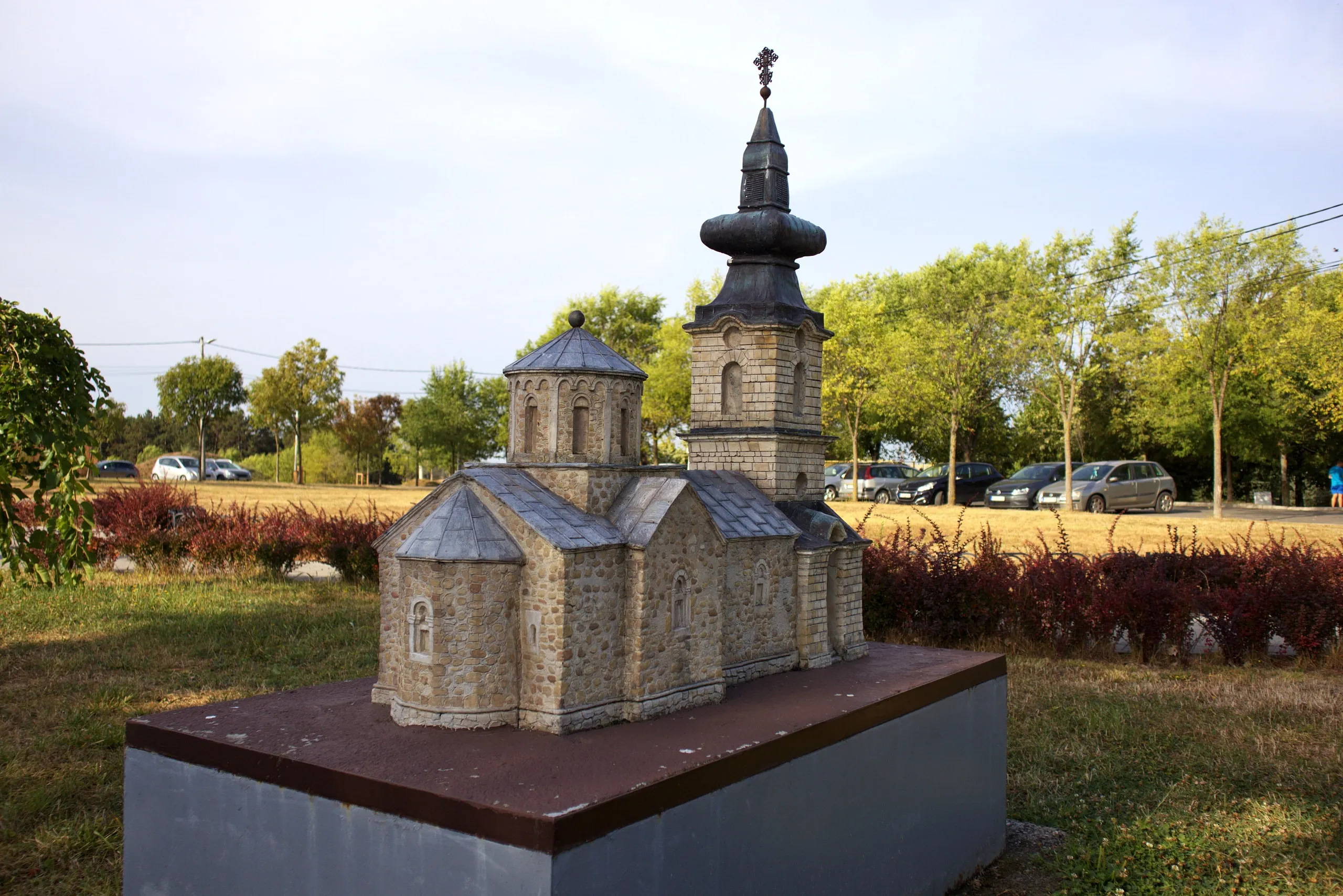
Tronoša
Monastery with the Church of the Presentation of the Most Holy Mother of God, in the Jadar region near Loznica · Korenita, Loznica
According to tradition, Tronoša near Loznica dates from the time of King Dragutin, and today's Church of the Presentation of the Mother of God was built in 1559. The boy Vuk Karadžić studied at the monastery school, and the Tronoša Chronicle was written here too.
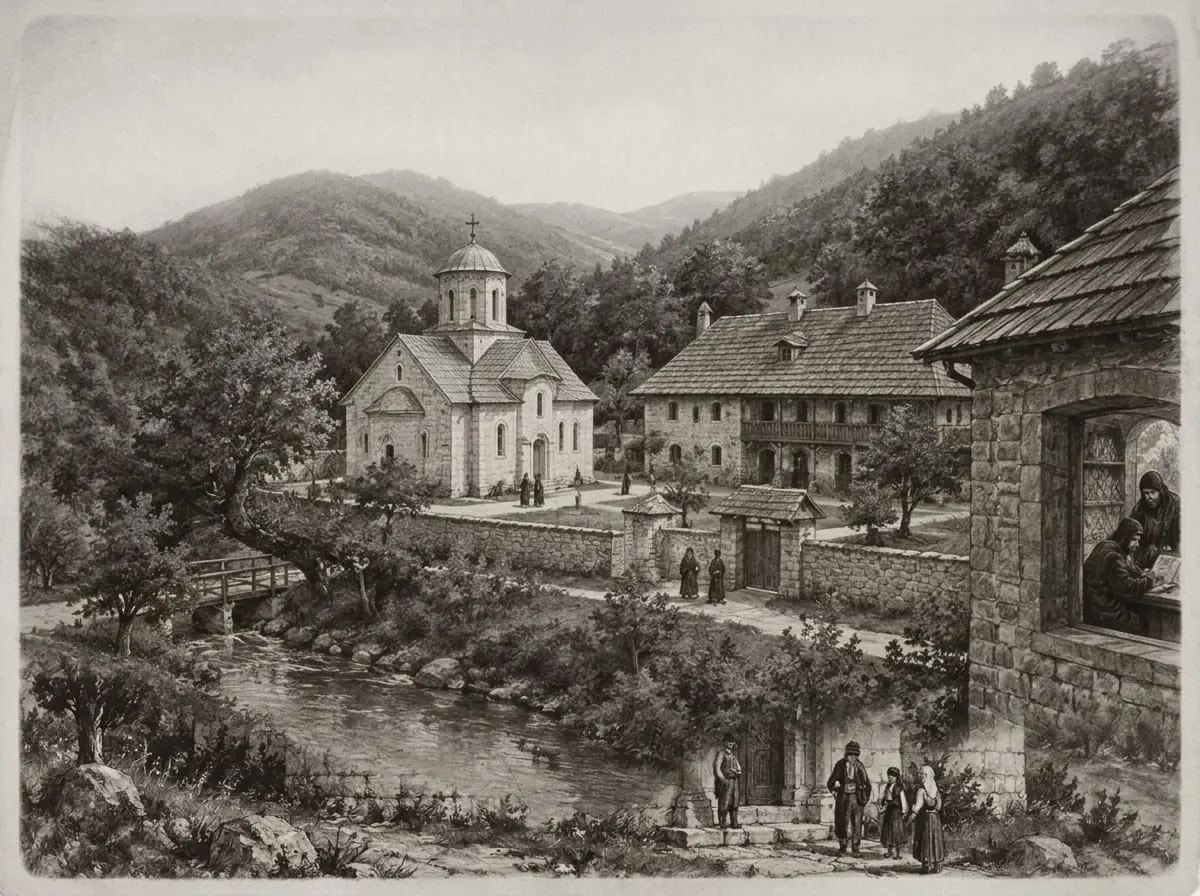
How it looked when it was built
Miniature and original
Gallery
Drag the slider and compare the miniature with the real Tronoša near Loznica. Look out for the dome and the Baroque spire of the bell tower.
History
In the wooded Jadar region, in the upper part of the village of Korenita, stands a monastery about whose beginnings people have more stories than there are surviving documents. Tradition ties it to the Nemanjić dynasty and a folk poem ties it to the Jugović brothers, but what is certain is that today's church has stood since 1559. Here, at the end of the 18th century, the boy Vuk Karadžić learned to read and write.
Read moreShow less
Tronoša lies in Gornja Mala, part of the village of Korenita, 17 kilometres south-west of Loznica. Its beginnings are wrapped in tradition. The Tronoša Chronicle of 1791 names Queen Katalina, the wife of King Dragutin, as the founder of the monastery, and on that basis its founding is placed in the year 1317.
A folk poem offers its own explanation. In the poem “Miloš among the Latins”, Tronoša is “the endowment of the Jugović brothers”, heroes of the Kosovo legend.
The firm ground of history begins in 1559. In that year, thanks to Abbot Pajsije with the brotherhood and the monks Arsenije and Genadije from the Papraća monastery, a church dedicated to the Presentation of the Mother of God was built. It was modelled on the old Raška churches. The church was painted as early as the 16th century, but only fragments of those frescoes survive, on the west wall of the narthex.
In the time of Prince Miloš the monastery was restored. In 1834 the church was painted again by the painters Mihailo Konstantinović from Bitola and Nikola Janković from Ohrid, who worked for the most distinguished founders in the Principality of Serbia. In the same year Nikola Janković also made the woodcarving and most of the icons for the iconostasis. In the 19th century a stone bell tower with a tall Baroque spire was added on the west side of the church.
Tronoša was a school as well. Before 1804 there were almost no secular schools in Serbia: children learned in monasteries, from the monks. Vuk Stefanović Karadžić, born in 1787 in nearby Tršić, first went to school in Loznica and then studied at Tronoša as a monastery pupil. He later described how in winter the pupils studied in a room that at Tronoša was called the “džagara”.
The monastery suffered in the Second World War, when many manuscripts were destroyed as well. Today Tronoša is a convent of the Eparchy of Šabac. Part of its former treasury is on display there, along with an exhibition about the school days of Vuk Karadžić. It is an immovable cultural property of great importance.
People and events
Founder according to tradition · 13th–14th century
Queen Katalina
A Hungarian princess, wife of the Serbian King Dragutin. The Tronoša Chronicle of 1791 names her as the founder of the monastery.Builder of the church · 16th century
Abbot Pajsije
Abbot of Tronoša thanks to whom, with the brotherhood and the monks Arsenije and Genadije from Papraća, today's Church of the Presentation of the Mother of God was built in 1559.Pupil of the monastery school · 1787–1864
Vuk Stefanović Karadžić
Born in Tršić, not far from Tronoša. After school in Loznica he studied at the Tronoša monastery, where he learned to read and write. He became the reformer of the Serbian language and alphabet and a collector of folk poems.Painter and woodcarver · 19th century
Nikola Janković
A painter from Ohrid who in 1834, with Mihailo Konstantinović from Bitola, painted the church and made the woodcarving and most of the icons of the iconostasis.Event · 1317
Founding according to tradition
According to the Tronoša Chronicle, the founder is Queen Katalina, wife of King Dragutin.Event · 1559
Building of today's church
Abbot Pajsije, with monks from Papraća, builds the Church of the Presentation of the Mother of God.Event · 1791
Tronoša Chronicle
A chronicle recording the history of Tronoša and the traditions about it is written in the monastery.Event · 1834
New frescoes and iconostasis
Restoration in the time of Prince Miloš: painters from Bitola and Ohrid paint the church.
From literature
а зими пошто би сви ујутру донијели дрва, и потом већи напојили калуђерске коње, а мањи почистили собе, скупили би се у каку собу (која се у Троноши звала џагара) те би им какав калуђер или ђакон показивао да уче читати
This is how Vuk Karadžić, in his book “The Life and Customs of the Serbian People”, describes the kind of monastery school he attended himself. In summer the younger pupils looked after the livestock and worked in the fields, and lessons took place only in winter.
Да видите лијепу Троношу Код Лознице на р'јеци Троноши, Задужбину браће Југовића
In the folk poem “Miloš among the Latins”, Miloš Obilić lists the most beautiful Serbian monasteries. The folk singer credits Tronoša to the Jugović brothers.
Architecture
Raška school
The Church of the Presentation was designed on the model of churches of the Raška building type. It is a single-nave building with a transept, a five-sided altar apse on the east and a narthex on the west side, roofed with barrel vaults.
Above the crossing of the nave and the transept rises a dome with eight vertical panels, separated by shallow pilasters that are joined at the top by a frieze of small blind arcades. In the middle of each panel is a narrow, elongated window. The portals and windows are carefully shaped with a two-stepped recess cut into the mass of the wall. On the west side is the 19th-century stone bell tower, with its tall Baroque spire.
Where is the original
Korenita, Loznica
Related monuments
Sources(5)
- Republički zavod za zaštitu spomenika kulture – Beograd, Manastir Tronoša (SK 363), Informacioni sistem nepokretnih kulturnih dobara, Republički zavod za zaštitu spomenika kulture (pristupljeno 4. 10. 2026), 2026
- Vikipedija (sr), Manastir Tronoša, Vikipedija na srpskom jeziku (pristupljeno 4. 10. 2026), 2026
- Jovan Skerlić, Vuk St. Karadžić, I, Tekst prema Vikizvorniku, revizija 143334, 1913
- Vuk Stefanović Karadžić, Život i običaji naroda srpskoga, VIII. Zakon ili vjera – Škola, U nakladi Ane udove V. S. Karadžića, Beč; tekst prema Vikizvorniku, revizija 139068, 1867
- Vuk Stefanović Karadžić (sakupio i izdao), Miloš u Latinima, u: Srpske narodne pjesme, knjiga druga, Tekst prema Vikizvorniku, revizija 15152