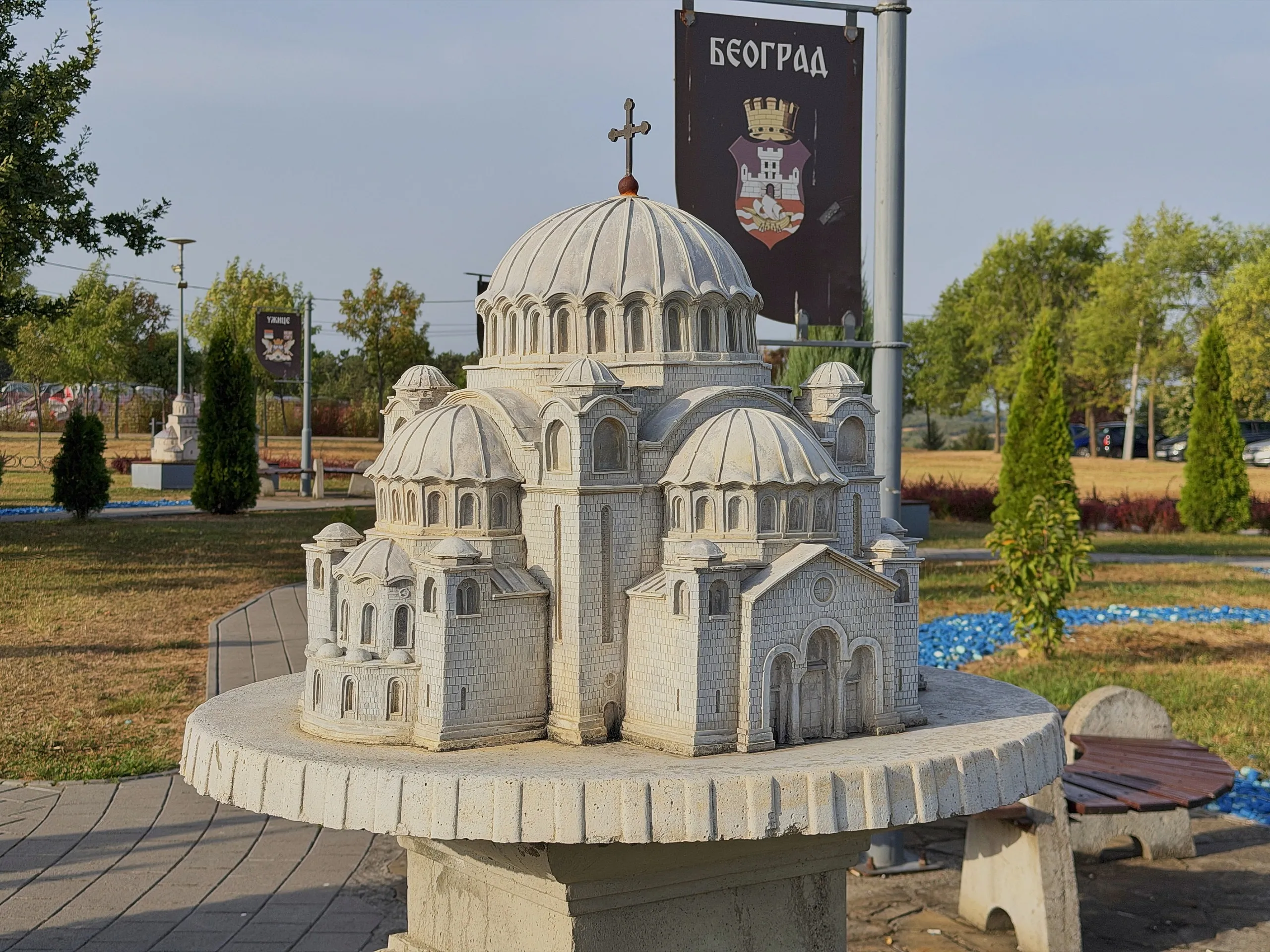
Church of Saint Sava
The cathedral church on Vračar, on the spot where the relics of Saint Sava were burned · Belgrade (Vračar)
The Church of Saint Sava on Vračar in Belgrade was built on the spot where, in 1594, the Turks burned the relics of the first Serbian archbishop. It was built, with interruptions, over almost the whole 20th century, and the mosaic inside was completed in 2020. It is one of the largest Orthodox churches in the world.
How it looked when it was built
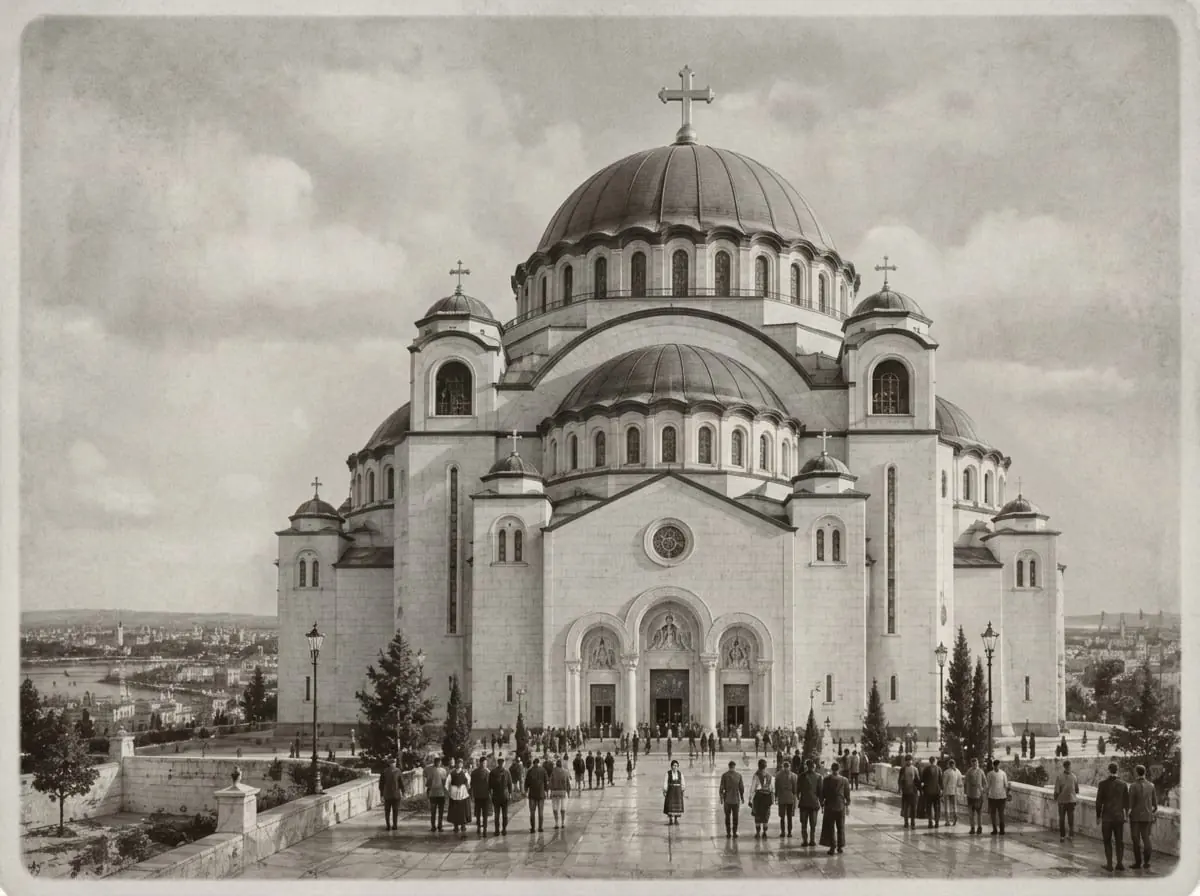
Miniature and original
Gallery
Drag the slider and compare the miniature with the real Church of Saint Sava on Vračar. Pay attention to the central dome and the four bell towers.
History
In 1594 the Turks brought the relics of Saint Sava from the Mileševa monastery to Belgrade and burned them on Vračar. Three centuries later the Serbs decided to build a church to their first archbishop on that very spot. The building work lasted, with long interruptions, almost the entire 20th century.
Read moreShow less
Saint Sava, the first Serbian archbishop and enlightener, was buried in the Mileševa monastery, where his relics had rested since 1237. At the end of the 16th century the Serbs rose in uprisings, carrying his image on their banners. For that reason Grand Vizier Sinan Pasha ordered the relics to be taken to Belgrade, where they were burned on Vračar on 27 April 1594.
Three hundred years later, in 1895, a hundred distinguished citizens of Belgrade, led by Metropolitan Mihailo, founded the Society for the Construction of the Church of Saint Sava on Vračar. The first design competition, announced in 1905, did not succeed: none of the five entries was accepted. The wars from 1912 to 1918 put the work off.
In a new competition in 1926 the second prize was awarded to the architect Bogdan Nestorović. The design was entrusted to him and to the architect Aleksandar Deroko, an expert on medieval art. Construction began in 1935. In the same year, to a design by the Russian architect Viktor Lukomski, the small church of Saint Sava was also built next to the building site.
The Second World War stopped the work in 1941. After the war the new authorities for a long time did not allow construction to continue: only after 88 requests from Patriarch German, in 1984, was permission granted. The continuation of the building was led by the architect Branko Pešić. The liturgy held within the walls of the church on 12 May 1985 was attended by about 12,000 believers inside the church and about 80,000 more in the churchyard.
The greatest feat was the dome, which weighs 4,000 tonnes. It was cast on the ground and then, together with its copper covering and gilded cross, lifted by hydraulic jacks onto the walls, to a height of 40 metres. The lifting was completed on the eve of Vidovdan, on 26 June 1989.
The exterior work, including the cladding of the façade in white marble, was finished in 2004. The interior, in keeping with the original idea, is decorated with mosaic. The project was carried out by the Russian Academy of Arts under the direction of the academician Nikolai Mukhin; over 15,000 square metres of mosaic were completed between 2016 and 2020. Beneath the church is a crypt with the church of the Holy Prince Lazar, where Serbian patriarchs are buried.
The church is part of the Saint Sava Plateau, which in 2021 was designated a spatial cultural-historical unit.
People and events
First Serbian archbishop · c. 1175–1236
Saint Sava
Nemanja's son Rastko, a monk, the first archbishop of the autocephalous Serbian church and an enlightener. He was buried in Mileševa, from where his relics were taken to Belgrade and burned on Vračar. The church is his cenotaph, a symbolic grave marker.Architect · 1901–1975
Bogdan Nestorović
A professor of architecture whose entry won a prize in the 1926 competition. Together with Aleksandar Deroko he is the author of the design of the church, which remained the basis for all later work.Architect · 1894–1988
Aleksandar Deroko
An architect and an outstanding expert on medieval art. He designed the church with Nestorović; the first capitals were carved from his drawings.Reviver of the construction · patriarch 1958–1990
Patriarch German
When he came to the head of the Serbian Orthodox Church, he revived the idea of continuing the construction. After 88 rejected requests, he received permission in 1984.Master builder · 20th century
Branko Pešić
A professor of architecture whom Patriarch German appointed master builder (protomajstor) in 1984. He adapted the original design to new materials and techniques and led the lifting of the dome.Event · 1594
Burning of the relics
By order of Sinan Pasha, the relics of Saint Sava were burned on Vračar.Event · 1895
Society for the construction of the church
Citizens of Belgrade found a society with the aim of building the church on the spot where the relics were burned.Event · 1935
Start of construction
Work begins to the design by Nestorović and Deroko; in 1941 it is interrupted by the war.Event · 1989
Lifting of the dome
The 4,000-tonne dome was lifted onto the walls on the eve of Vidovdan.Event · 2016–2020
Mosaic
Russian and Serbian craftsmen cover the interior of the church with mosaic.
From literature
Али се при том Турци преварише. Они спалише само мртво тело светитељево; а родољубиви дух његов живи у целом склопу Српске Православне Цркве и стално загрејава сва српска срца жарком љубављу за народ и веру своју.
This is how the church historian Radoslav Grujić wrote in 1921 about the burning of the relics on Vračar. The church that stands on that spot today is an answer to the same thought: the fire did not destroy the memory of Saint Sava.
Друштво за подизање храма Светог Саве оснива се са задатком да оствари давнашњу жељу васколиког Српства подизањем велелепног Храма на Врачару, као месту на којем су спаљене свете мошти Божјег угодника и првог српског архиепископа и просветитеља.
So reads the first article of the Rules of the Society founded in 1895. From those words to the consecrated church, more than a century passed.
Architecture
Serbo-Byzantine style
The 1926 competition asked for a church “in a freely modernised Serbian-Byzantine style of Lazar's era”, for 6,000 believers. Hagia Sophia in Constantinople and Gračanica were considered as models. Today the church has a ground plan in the shape of a Greek cross, with a dome over the nave. It is 91 metres long in the east–west direction and 81 metres in the north–south direction; the height to the dome is 65 metres, and with the cross 79 metres. The interior is a single space, without partitions.
The façade is clad in white marble, and the finishing cornices around the domes and semi-domes are made of red granite. On the church you can see four bell towers, eight small towers and five conches. The dome has an inner diameter of 30.5 metres; with the circular gallery on the outside, 39.5 metres.
Where is the original
Belgrade (Vračar)
Related monuments
Sources(7)
- Republički zavod za zaštitu spomenika kulture – Beograd, Svetosavski plato u Beogradu (PKIC 93), Informacioni sistem nepokretnih kulturnih dobara, Republički zavod za zaštitu spomenika kulture (pristupljeno 4. 10. 2026), 2026
- Hram Svetog Save, Istorijat Hrama Svetog Save, Hram Svetog Save, Beograd (pristupljeno 4. 10. 2026), 2026
- Hram Svetog Save, Arhitektura i gradnja Hrama, Hram Svetog Save, Beograd (pristupljeno 4. 10. 2026), 2026
- Hram Svetog Save, Fasada Hrama Svetog Save, Hram Svetog Save, Beograd (pristupljeno 4. 10. 2026), 2026
- Hram Svetog Save, Kupola Hrama Svetog Save, Hram Svetog Save, Beograd (pristupljeno 4. 10. 2026), 2026
- Radoslav Grujić, Pravoslavna srpska crkva, prvi deo – Stara srpska crkva, Beograd (fototipsko izdanje Kragujevac 1995); tekst prema Vikizvorniku, revizija 48783, 1921
- Vikipedija (sr), Hram Svetog Save, Vikipedija na srpskom jeziku (pristupljeno 4. 10. 2026), 2026